

Your chest tightens before the meeting starts.
Your jaw sets after one sharp email.
You keep typing, but your breathing goes shallow, fast, and high in the chest.
That's the trick anxiety pulls at work. It changes your breathing first, then it changes your decisions.
The good news is blunt: breathwork for anxiety at work can work because breathing is one of the few stress signals you can steer on purpose. Slow it down, and your body gets the memo. The alarm system backs off. You get a little room to think.
And yes, this is common. Recent US workplace data suggests roughly half of workers report moderate to severe burnout, depression, or anxiety, not "a little stressed", but meaningfully affected.
This post gives office-friendly breathwork that takes 1 to 5 minutes. No gear. No yoga voice. No meditation skills. It also matches why Pausa exists: it was built after real panic attacks, and it focuses on simple guided breathing that helps from day one.
Why breathwork helps anxiety at work (even in 5 minutes)
 An office-friendly pause for slow breathing, created with AI.
Work stress isn't abstract. It hits the body like a fire alarm.
Heart rate up. Breathing up. Shoulders up. Thoughts louder.
That's your sympathetic nervous system, the "go" mode. It's useful for sprinting. It's bad for judgment, listening, and clean communication.
Slow breathing nudges the opposite system, the parasympathetic "calm" mode. It doesn't erase pressure. It changes your internal speed so you can handle it.
Two mechanics matter for leaders:
First, heart rate variability (HRV). In plain language, HRV is a sign your body can shift gears instead of getting stuck. Slower, steady breathing tends to improve HRV in the moment, and with repetition it can support better regulation under load.
Second, vagal tone. Think of the vagus nerve as a brake line. When it works well, you can downshift faster after a spike. Controlled exhale-heavy breathing is one way to press that brake.
This isn't wellness theater. Research reviews keep landing on the same conclusion: breathing exercises reduce stress and anxiety symptoms across many groups. A good starting point is this meta-analysis of randomized breathwork trials, which found measurable improvements in stress-related outcomes.
For a CEO, the appeal is simple:
- Low cost, because breathing is free.
- Low time, because 60 seconds can interrupt a spiral.
- Low friction, because nobody needs a mat, a room, or a new identity.
When anxiety runs meetings, you get more mistakes. More rework. More conflict. Breathwork is a small control knob that helps protect quality.
What changes in your body when you breathe slowly on purpose
Your heart rate eases. Not instantly, not magically, but enough to notice.
Your muscles unclench. Jaw, neck, shoulders. The armor loosens.
Your thoughts get quieter. Not gone, just less grabby.
Your reaction time improves. You can choose a response instead of firing back.
Breathwork isn't about forcing calm. That usually backfires.
It's about creating space. Space to read the email twice. Space to ask one better question. Space to stop making fear-based decisions.
3 discreet breathwork exercises you can do at your desk or between meetings
 A quick reset between messages, created with AI.
These are built for real workplaces. They don't look strange. You can do them in a chair, on a call (muted), or walking to the next room.
Two guardrails:
If you feel dizzy, stop and breathe normally. Don't push through.
If anxiety is intense, frequent, or escalating, consider professional support. Breathwork helps, but it's not a medical diagnosis or a full plan.
If you want guidance without overthinking, Pausa offers guided versions of these patterns. That matters when you're stressed and your brain wants to argue with instructions. Pausa was born from panic attacks, and it's designed to feel simple, not ceremonial. Short sessions, clear cues, and a sense of companionship when you don't want to do it alone.
Box breathing for steady nerves before a presentation
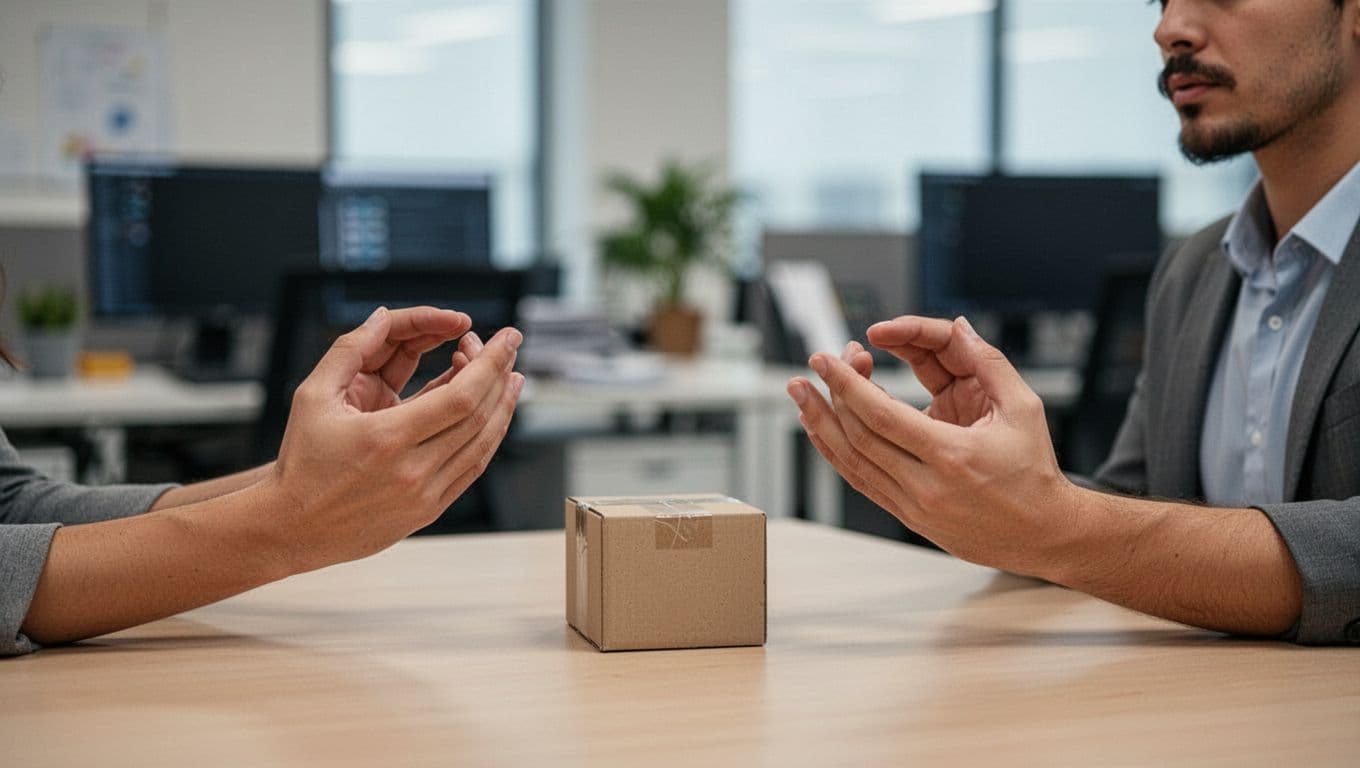 A discreet, structured breathing pattern at a desk, created with AI.
Box breathing is boring on purpose. That's why it works. It gives your mind a simple box to stay inside while adrenaline tries to pull you away.
Use it when you need steady nerves: before a board update, before a sales call, right after a tough Slack message, or when you feel yourself getting sharp.
Steps (1 to 2 minutes):
- Inhale through your nose for 4 seconds.
- Hold for 4 seconds (gentle hold, not a strain).
- Exhale slowly for 4 seconds.
- Hold for 4 seconds.
- Repeat 4 to 5 rounds.
What it feels like when it's working: less rush in the chest, fewer "urgent" thoughts, more control in your voice.
This pattern shows up in high-stress jobs because it's structured and repeatable. No interpretation. No vibe. Just timing.
Cyclic sighing for fast relief when your chest feels tight
Sometimes anxiety is not subtle. It hits like a wave. Chest tight. Breathing stuck. A little panic creeping in.
Cyclic sighing (often called a physiological sigh) is a fast way to downshift because the long exhale signals safety to the body. Your system hears, "We're not running."
Steps (1 to 3 minutes):
- Inhale through your nose.
- At the top, take a second small inhale (like topping off the lungs).
- Let out a long, slow sigh through your mouth.
- Repeat at a calm pace.
Do it after conflict. Do it after you read something that spikes you. Do it when you feel a panic-like surge starting.
If you want more detail on why exhale-led methods help, this open review on breathing practices for stress and anxiety reduction explains how different patterns can be implemented and why slow breathing tends to be a reliable baseline.
What it feels like when it's working: the chest loosens, the urge to flee drops, and your eyes stop scanning for threats.
One note for the office: keep it quiet. The "sigh" can be subtle. Think slow release of air, not a dramatic sound.
Resonant (coherent) breathing when you need focus without the jitters
Resonant breathing is the "work mode" breath. Calm, but alert. It's useful when caffeine is pushing you into shaky focus.
The target is simple: roughly 5 seconds in, 5 seconds out. That's about 6 breaths per minute. Adjust by a second if it feels forced. Comfort wins.
Steps (3 to 5 minutes):
- Set a timer for 3 to 5 minutes.
- Inhale for about 5 seconds (nose if you can).
- Exhale for about 5 seconds (nose if comfortable, otherwise mouth).
- Keep shoulders loose, jaw unclenched, and breathing quiet.
This pattern is often linked to HRV improvements, which is a fancy way of saying your system regains flexibility.
It also shows up in office-specific research. A simulated workplace study in Scientific Reports found that guided resonant breathing improved stress recovery after pressure tasks. See light-guided resonant breathing in an office environment for the full methods and outcomes.
What it feels like when it's working: your attention narrows, the "edge" comes off, and you stop switching tabs like it's a personality trait.
How leaders can make breathwork normal at work, without making it weird
 A leader setting a calmer pace in a meeting, created with AI.
Most wellness tools get ignored because they ask for too much. Too much time. Too much belief. Too much public performance.
So keep it small. Keep it optional. Keep it normal.
If you want people to use breathwork at work, remove friction:
- Make the pause short (60 seconds is enough to start).
- Make it opt-in (no forced vulnerability).
- Make it private (nobody should have to "share feelings" on command).
- Make it repeatable (same cue, same pattern, same time window).
That's also where an app helps, if it's built for adoption. Pausa is designed for quick, guided sessions, not long meditations. It's also built around a hard truth: not everyone meditates, but everyone breathes.
If you want to try it personally first, start with the simplest step: download Pausa and run one 3-minute session after your next stressful message.
For organizations, Pausa Business takes the same idea and scales it as a B2B2C tool: your company licenses the app, each colleague gets access on iOS or Android, and they can start reducing stress from day one. No training block. No heavy rollout. The platform can also support better habits with features like gentle screen time locks that interrupt scrolling, mood tracking that recommends the right technique, and short structured journeys that build consistency. Importantly, reporting is designed to be fully anonymized, so you can see adoption without turning wellbeing into surveillance.
If you're also coaching managers on what to say, keep language practical. That's the tone people trust. This internal post on practical ways to explain how you manage stress nails the "system, not story" approach, and it translates well to manager scripts.
A simple 2-week rollout plan that fits real calendars
Week 1: leaders model the pause.
Start one meeting a day with 60 seconds of slow breathing. No speeches. Just, "Let's take one minute to reset." Then do box breathing or resonant breathing. Also invite people to try it after hard meetings, not only at the start of the day. That's when the nervous system actually needs it.
Week 2: pick one shared moment.
Let the team choose a single anchor: start of day, post-lunch, or pre-demo. Keep it consistent for two weeks. Track participation lightly, if at all. If you track anything, track engagement in aggregate, not names.
If you use an app approach, optional mood check-ins can help personalize guidance. That's useful because "stressed" and "wired" aren't the same state, and they don't need the same breath.
Bottom line: you're not building a mindfulness brand. You're building a steadier operating system.
Conclusion
Work anxiety doesn't need a ritual. It needs an interrupt.
Use box breathing to steady nerves before you speak.
Use cyclic sighing to break a tight-chest spike fast.
Use resonant breathing to focus without jittery urgency.
Small pauses add up. Better focus. Fewer stress spikes. Cleaner communication when stakes are high.
If you lead people, go first. Keep it short. Keep it normal. That's how it spreads without turning into a performance.
Tomorrow, pick one moment, before a meeting, after a conflict, or at 3 pm, and do 60 seconds of breathing. That's the next step. If you want consistent guidance for yourself or your team, Pausa and Pausa Business can make the habit easier, without forcing meditation or long sessions.