

Pressure doesn't show up politely.
It hits in board updates, crisis calls, high-stakes sales meetings, and the conversation you've been avoiding for weeks. Your mind calls it "stress." Your body calls it an emergency. Heart rate climbs. Chest tightens. Thoughts speed up. Your voice gets sharper than you want.
That's not a mindset issue. It's a nervous-system state.
Breathwork is one of the few tools that can change that state fast, without leaving the workday. No candles. No hour-long sessions. One to five minutes is enough to shift your output.
Pausa exists because panic attacks are real, and because "just calm down" isn't advice. The app was built after two panic attacks forced a simple question: what actually works when breathing feels impossible? The answer wasn't complicated routines or long meditation. It was short, guided, science-backed breathing you can do anywhere, even if you don't "do mindfulness." Quick pauses. Real change. Plus a quiet kind of companionship: you're not doing it alone, even when you are.
Why breathwork helps you perform under pressure (it's biology, not hype)
 An executive using discreet breathing to stay steady during a tense meeting, created with AI.
Stress isn't abstract. It's a switch.
Your brain detects threat (real or imagined), then your body ramps up. Fight-or-flight kicks in. Cortisol and adrenaline rise. Blood flow shifts. Attention narrows. You can still function, but you get simpler, faster, and worse at nuance.
That "worse at nuance" part is where leaders lose money.
Breathing matters because it's one of the only inputs you can change on purpose that talks directly to that stress system. Slow, controlled breathing supports the parasympathetic branch (the downshift). It can reduce perceived stress and steady attention, which is what you need when the room is watching.
Research keeps circling the same idea: breathing patterns influence how the brain regulates emotion and control. Imaging work also links controlled breathing to stronger top-down control from the prefrontal cortex, and calmer reactivity in fear circuits. That's not a vibe. That's an operating system update.
If you want a recent, concrete example that connects nasal breathing to self-regulation measures, see this 2026 paper in Scientific Reports on nasal breathing and self-regulation effects.
The pressure loop leaders get stuck in
Pressure triggers fast breathing. Fast breathing signals danger. Then the mind locks onto the loudest input in the room.
That loop shows up as:
- You talk faster and say less.
- You interrupt because silence feels risky.
- You send reactive emails to "clear the queue."
- You miss small numbers, or you miss the one stakeholder who's quietly disagreeing.
In executive settings, the loop gets reinforced. Everyone mirrors everyone. If you're tense, the room tightens. If you rush, the room speeds up.
Breathwork breaks the loop because it changes the signal your body is sending. You stop telling yourself the building is on fire.
The goal isn't to feel peaceful. The goal is to stay in charge of your next decision.
Calm isn't soft, it's a performance advantage
Calm looks boring. Good. Boring is reliable.
A regulated state gives you cleaner thinking and steadier delivery. You listen better. You ask better questions. You don't "win" the moment and lose the relationship. You also make fewer unforced errors, which is the hidden tax of stress.
Short daily practice helps because it builds familiarity. Ten minutes a day of paced breathing has been linked in trials to meaningful stress reduction and measurable attention benefits. No guarantees, no miracles, just a noticeable shift in baseline for many people when they practice consistently.
A simple breathwork playbook for high-stakes moments (before, during, after)
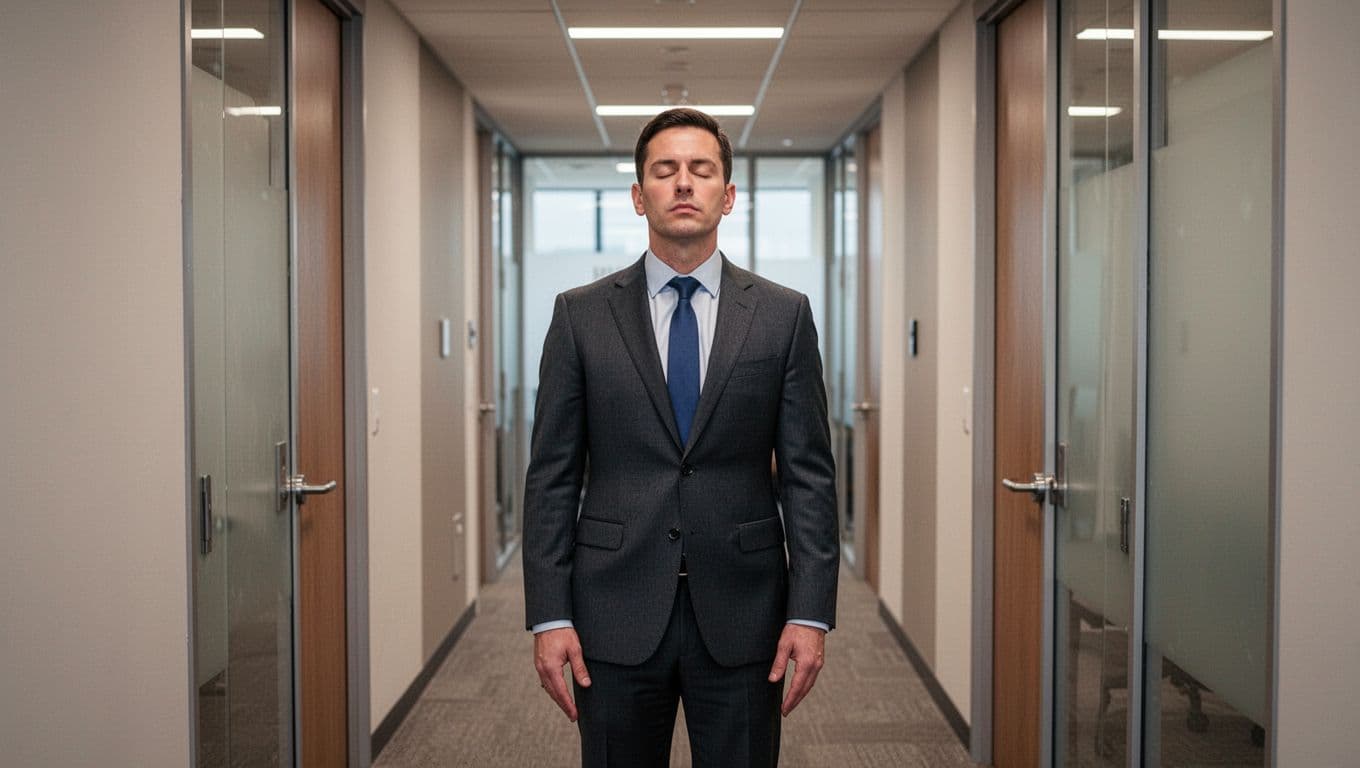 A leader using a quick breathing reset before walking into a meeting, created with AI.
This is the part that needs to work in real life.
Not in a retreat. Not in perfect quiet. In the hallway. On Zoom. While someone talks too much and you're still expected to think clearly.
Use this framework:
- Before: prime your system, so you don't start from redline.
- During: regulate without anyone noticing.
- After: recover on purpose, so stress doesn't leak into the next block.
One safety note: if you feel dizzy, stop and breathe normally. If you have a health condition or concerns, check with a clinician before doing intense breathing styles.
Before the event, get steady in 2 minutes with box breathing
Box breathing is simple because it's symmetrical. Equal counts. Clear edges. It's a good "pre-flight checklist" for your nervous system.
Do this for 2 minutes:
- Inhale through your nose for 4.
- Hold for 4.
- Exhale through your nose (or softly through pursed lips) for 4.
- Hold for 4.
- Repeat.
Use it before presentations, negotiations, conflict conversations, investor calls, or any meeting where you can feel yourself getting sharp.
Make it frictionless. Stack it onto something you already do:
- While opening the calendar invite.
- While waiting for Zoom to connect.
- While your hand is on the conference room door.
The point is consistency, not heroics. Two minutes is enough to stop the spiral.
During the moment, reset fast with a calming exhale
In the room, you don't need a full routine. You need a small correction.
Try this while you listen:
- Inhale through your nose for 3 to 4 seconds.
- Exhale for 6 to 8 seconds.
- Pause for 1 second, then repeat 3 to 6 cycles.
Longer exhales tend to downshift arousal because they nudge the body toward "safe enough." You're basically telling your system, "If I can exhale slowly, I'm not being chased."
No one notices. Your face stays neutral. Your voice steadies because your airflow steadies.
Guided sessions help here because you don't have to count under pressure. You just follow. If you want that kind of support between meetings, download Pausa for guided breathwork and run a 1 to 5 minute session when stress spikes.
If you're curious how breathwork shows up in more formal trials (not just anecdotes), this 2025 Scientific Reports study on a breathwork and cold immersion control trial is a useful reference point for psychophysiological effects.
After the pressure, recover so you don't carry stress into the next meeting
Most leaders don't fail in the meeting. They fail in the next one, because they never come back down.
Recovery is performance hygiene.
A simple 3 to 5 minute wind-down:
- Breathe at about 6 breaths per minute (roughly 5 seconds in, 5 seconds out).
- Keep it nasal if you can.
- Let your shoulders drop on the exhale.
Do it after the event, not at the end of the day. Otherwise you bank stress for hours, then wonder why sleep feels thin and your patience disappears.
Consistency matters more than intensity. Three minutes after three stressful meetings beats one heroic session at night that you skip next week.
How to make breathwork stick across a company without turning it into another chore
 A team taking short breathing pauses at their desks, created with AI.
Most corporate wellness fails for predictable reasons.
Too much time. Too much explaining. Too much forced sincerity. People smell homework and avoid it.
Breathwork can scale if you treat it like a performance tool. Short inputs. Clear triggers. Private by default. Measurable engagement, not personal exposure.
Pausa Business is built around that model. Setup is fast. The company buys access, then employees download the app on iOS or Android. Guided breathing works from day one, with no training required. On the behavior side, it supports habit formation with short sessions, mood-based recommendations, a 10-day journey that teaches the basics without getting preachy, and streaks that make consistency visible.
For leaders who want a broader business framing, this overview on breathwork in leadership and workplace culture aligns with what most teams actually need: better regulation, better communication, fewer stress-driven mistakes.
Just as important, Pausa Business is designed around anonymized reporting, so you can see adoption and engagement trends without turning wellbeing into surveillance.
What high adoption looks like in the real world
Adoption doesn't come from posters. It comes from timing.
Micro-pauses win because they fit where stress actually happens:
- After a hard meeting: a 3-minute reset, so tension doesn't spill into Slack.
- Before giving feedback: 60 seconds to slow your speech and soften your tone.
- After travel or back-to-back calls: 5 minutes to stop living in adrenaline.
This is also why "meditate for 20 minutes" rarely lands. The ask is too large. People don't reject wellness, they reject friction.
If you want language that's direct and work-safe, this Pausa Business post on practical stress management under pressure has a useful framing: stress is normal, the goal is having a process.
A leader-friendly rollout that respects privacy and time
Keep rollout simple, or don't do it.
A lightweight approach that doesn't make people cringe:
- Send a kickoff note from leadership framing breathwork as performance support, not therapy.
- Offer an optional team challenge (7 days, 1 to 3 minutes per day). Keep it opt-in.
- Add one weekly reminder tied to real work moments (before customer calls, after incident reviews).
For scale, workshops can teach the "why" and the basic techniques. Then the app does the daily work. That mix matters because attention is scarce, and leaders shouldn't have to become wellness coaches to support their teams.
Conclusion
Pressure is normal. The mistake is treating it as purely mental.
Performance under pressure comes from regulation. Regulation comes from signals. Breathing is one of the fastest signals you can control, in public, in real time, without changing your calendar.
Pick one technique for your next high-pressure moment, box breathing before, long exhale during, slow recovery after. Practice it for a week. Not forever. Just long enough to prove it works.
That's the Pausa approach: simple guided breathing for real life, built by people who needed something that worked in the middle of panic, not after it. For teams, Pausa Business gives you a scalable way to reduce stress load and support steadier focus, without turning wellbeing into a performance.