Burnout isn't a soft problem anymore. It's an operating problem.
Recent US surveys rolling into 2026 put burnout and high stress somewhere between the low-50% range and the 70%+ range, depending on the workforce. That's not a rounding error. It's half your org, on a normal Tuesday. Meanwhile, research summaries used in workplace reporting keep landing on the same ugly pattern: teams with high burnout can run about 18% to 20% less productive, take more sick days, and show a much higher quit risk (often 2 times or more).
So no, choosing an employee wellbeing vendor isn't a perk decision. It's a performance decision.
This post gives you a simple selection process that doesn't depend on hype: define needs, set measurable goals, score vendors, run a short pilot, then decide with data.
Start with what your people actually need, not what vendors are selling
 Leaders aligning on real employee needs before picking a program, created with AI.
A vendor demo is a story. Your workforce is the plot.
Start with risk, not features. Burnout. Stress. Sleep. Focus. Retention. Then reality: remote teams, shift work, frontline staff, language needs, phone access, and whether people can take a break without getting side-eyed.
Most wellbeing programs fail for one boring reason. People don't use them. Not because they hate wellness, but because the tool doesn't fit the day. A one-size program is fine for a one-size company. That isn't you.
Here's a fast "needs snapshot" you can copy into a doc and share with HR and Ops:
- Top strain: stress, anxiety spikes, sleep debt, focus crashes, or emotional exhaustion
- Where it happens: after customer calls, after meetings, at shift start, after-hours, commute
- Work shape: remote, hybrid, on-site, field, or 24-7 coverage
- Access: personal phones allowed, shared devices, low bandwidth, limited email
- Language and culture: English-only, bilingual, or truly multilingual
- Support style: self-serve app, short live sessions, coaching, workshops, or a mix
- Trust barriers: privacy fears, manager skepticism, "don't have time" pressure
The best vendors don't force behavior. They reduce friction. They let people choose what fits the moment. That's where personalization wins, not as a gimmick, but as a way to meet different nervous systems on the same team.
Run a simple needs check in 10 days
You don't need a six-month committee. You need signal.
Run a quick 10-day needs check:
First, send a 5-question pulse survey. Keep it anonymous. Keep it short. Then run three 20-minute focus groups (one frontline, one managers, one mixed). If you have benefits claims or EAP utilization reports, review them for themes, not "gotcha" conclusions. Finally, ask managers one direct question: "Where do you see strain showing up?"
Sample survey questions that actually produce useful answers:
- "In the last two weeks, how often did you feel high stress at work?"
- "How's your sleep on work nights?"
- "When do you lose focus most often?"
- "Do you get anxiety spikes during the day?"
- "What support would you use, if it took five minutes?" (app, coaching, workshop, peer support)
If feedback isn't anonymous, it's not feedback. It's theater.
Make privacy the default, because honesty needs cover.
Pick 2 to 3 measurable goals before you talk to vendors
Vendors love vague goals because vague goals can't fail.
Pick 2 to 3 measurable goals up front. Tie them to what you can track without invading anyone's life. Examples: perceived stress, focus during intense workdays, absence trends, retention risk signals, or after-hours work patterns.
Use a simple table like this to force clarity:
| Goal | Baseline (now) | Target | Timeframe | How we'll measure |
|---|---|---|---|---|
| Reduce perceived stress | Pulse score | -10% to -15% | 60 days | Anonymous pulse survey |
| Improve focus | Self-rating | +10% | 60 days | Weekly 1-question check-in |
| Reduce absence days (proxy) | HR data | -5% | 90 days | Absence trend by team |
The point isn't perfection. It's a shared definition of "working."
If you want more practical, no-fluff guidance from a vendor perspective, the Pausa Business blog on workplace stress relief is a solid reference library for how stress shows up at work and what short interventions can look like.
Use a vendor scorecard that favors adoption, outcomes, and trust
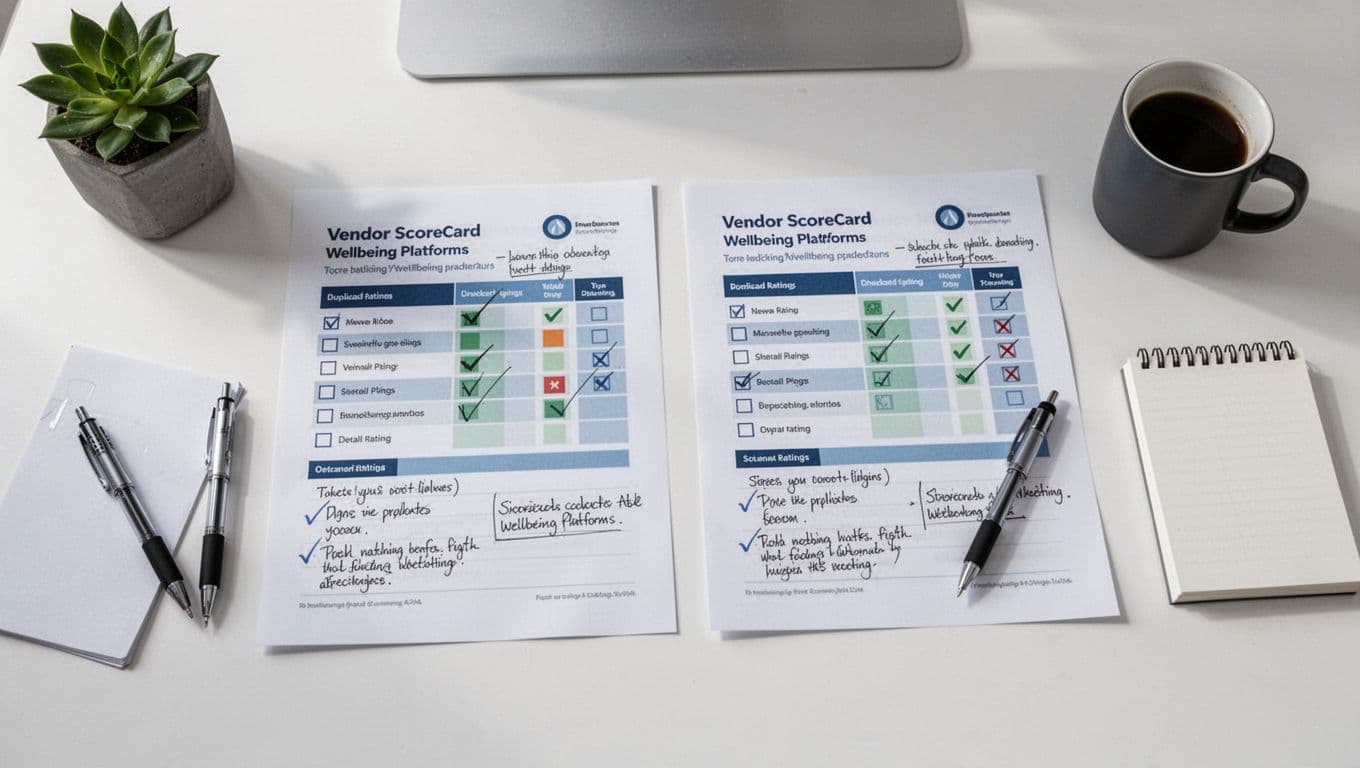 Comparing vendors with a clear scorecard instead of vibes, created with AI.
Most vendor comparisons go wrong in the same place. Leaders score "features," not outcomes. Then they buy a platform employees ignore.
In 2026, selection signals are pretty consistent across buying teams: pricing matters, flexibility matters, access matters. Reporting matters too, but only after adoption. A dashboard full of zeros is still a dashboard.
Build a scorecard that rewards what you actually need:
- Trust: privacy, security posture, data handling, clear boundaries
- Adoption: time to first value, ease of onboarding, low manager burden
- Outcomes: measurable changes with baseline and timeframe
- Access: iOS and Android, low bandwidth, multilingual options if needed
- Support: implementation help, comms templates, admin tools, responsiveness
- Commercials: total cost, pilot terms, and exit options
If you want a wider view of what's on the market this year, this curated list of employee wellness software reviews for 2026 helps you map categories before you shortlist.
The non-negotiables: privacy, accessibility, and inclusive design
This part isn't exciting. It's still where deals should die.
On privacy, verify the basics in writing:
Data should be anonymized or aggregated in employer reporting by default. The vendor should be clear about data ownership. They should collect the minimum needed to deliver the service. Sensitive mental health data needs strict handling, not loose "we take security seriously" language.
On accessibility, don't accept "works on mobile" as an answer. Confirm it's available on iOS and Android, usable with spotty internet, and designed for short sessions. If your workforce isn't English-only, multilingual support isn't a nice add-on. It's table stakes.
Inclusive design matters too. Not everyone relates to the same tone, examples, or daily rhythm. Your vendor should show you how the content works for different roles, cultures, and schedules.
Look for evidence it works in real life, not just glossy marketing
Marketing can make anything look effective. Real life can't.
At a CEO level, "proof" should look like this:
- Baseline vs after, with clear definitions
- Adoption rates (not just installs)
- Time to value (weeks, not quarters)
- Outcomes tied to business proxies (absence, retention, performance)
Burnout isn't just a feeling. It hits output and churn. So vendors should connect outcomes to the business reality, without promising magic.
Red flags show up fast:
Vague ROI claims. No baseline. No definition of "active user." "We improved wellbeing" with no measurement model. A wall of testimonials, but no numbers.
If you want a practical set of vendor questions to pressure-test claims, this list of questions to ask a wellness vendor is a useful template.
Adoption is the product, test for zero-training ease
If it needs training, it won't scale. If it needs "champions," it'll fade.
Test adoption like you'd test any product:
How fast does someone get value? Can they feel better in five minutes? Is the first session obvious? Do reminders help without nagging? Does the tool build habits without turning into homework?
Low friction can look like:
Guided breathing that works from day one. Mood-based recommendations that match stress, focus, energy, or calm. Short learning paths (for example, a 10-day journey that takes someone from beginner to confident). Streaks that build consistency without shame. Optional screen-time interrupts that replace scrolling with a quick reset.
Those details matter because stress doesn't wait for a calendar invite. People need something they can use after a hard meeting, before a client call, or when their chest tightens at 10:47 pm.
For context on why analytics and personalization keep showing up in modern programs, this 2026 discussion of data-driven corporate well-being analytics frames the trend well, with a fair warning about low utilization when tools don't fit behavior.
Pricing and contracts: focus on total cost and exit options
Price matters. So does waste.
Ask vendors for the full cost picture: per-employee pricing vs tiers, minimum seats, annual vs monthly options, implementation fees, pilot pricing, and support costs. Then ask the question that reveals confidence: "What happens if we leave?"
You want clear cancellation terms, clean data handling on exit, and no trap-door renewals.
Also, don't buy features your people won't touch. The cheapest platform with low adoption is expensive. The most feature-packed platform with low adoption is worse.
Run a short pilot, then decide with real numbers
 Testing a simple, time-boxed pilot that fits the workday, created with AI.
A pilot is where vendor stories meet your company's physics.
Keep it short, 30 to 60 days. Keep it real. If the program can't show traction in that window, it probably won't show traction later. You're not trying to prove enlightenment. You're trying to prove usage and impact.
Short, guided interventions often pilot better than long programs because they fit inside the day. Five minutes is a meeting gap. Thirty minutes is a lie most teams tell themselves.
A 30 to 60 day pilot plan that busy teams will actually finish
Pick one or two groups. Mix roles. Don't stack the deck with only wellness fans.
Set success metrics before the first email goes out. Then keep communications simple:
Two reminders per week is enough. One message should come from a senior leader. Not a speech, just permission. The second should come from the program owner with a direct call to action.
During the pilot, watch for these signals:
Activation rate (did people start?). Weekly active use (did they come back?). A small, anonymous stress shift measure (did it help?). Qualitative notes (what felt easy, what felt awkward, what didn't fit shift life).
Also, track manager burden. If managers have to "run" the program, it won't last.
What to measure, and how to avoid fake wins
You need four buckets of KPIs. Anything else is noise.
- Adoption: downloads, account activation, first session completion
- Engagement: weekly active users, repeat sessions, streak trends
- Outcomes: stress rating change, focus rating change, sleep self-report (optional)
- Business proxies: absence trends, retention signals, after-hours work patterns
Avoid vanity metrics. "Emails sent" isn't usage. "Installs" isn't behavior change.
This is also where it helps to try a tool that delivers fast, in-the-moment relief. For example, Pausa is a guided breathing app for stress and anxiety, available on iOS and Android. It's built for short pauses, not long routines, which makes it easier to test with real schedules.
When you evaluate a business offering like Pausa Business, look for the B2B2C basics: quick setup, an admin panel to manage access, and reporting that stays fully anonymized while still showing engagement and trend-level outcomes. That's the balance you want, insight without surveillance.
Conclusion: choose the vendor that survives real life
Choosing an employee wellbeing vendor should feel boring in the best way. Clear needs. Clear goals. Clear proof.
Here's the three-step approach that holds up: (1) define needs and pick 2 to 3 measurable goals, (2) score vendors on non-negotiables plus adoption and trust, (3) run a 30 to 60 day pilot and decide with real numbers.
The right vendor reduces friction. It supports people in the moment (stress, focus, calm). It protects privacy by design. It shows impact without pretending to fix everything.
If you want a low-friction example to evaluate, book a demo of Pausa Business and pressure-test it like you would any system: guided breathing that works from day one, quick org setup, and anonymized reporting that leadership can actually use.

