Your team's good. Maybe too good.
They keep shipping. They keep catching problems. They keep saying "no worries" while their calendars look like a Tetris game with no gaps. Meanwhile, hiring is frozen or slow, deadlines keep coming, and burnout starts to show up as the usual suspects: chronic overload, cynicism, lower output, more mistakes, and higher churn.
Here's the part most leaders miss: burnout is rarely a staffing problem first. It's a work-design problem. A priority problem. A recovery problem.
This is a practical plan to reduce burnout without lowering standards. You'll change the system your team runs on. You'll also add small, repeatable pauses (3 to 5 minutes) that help people reset between meetings, instead of carrying stress forward like a bad debt.
Find what is draining your team first (before you try to fix it)
 Photo by Nataliya Vaitkevich
You can't fix what you won't name.
So start with a fast diagnostic. One to two weeks. No new tools. No big initiative. Just signal hunting.
The goal is not to "toughen people up." It's to remove friction. That requires psychological safety, because people won't tell the truth if honesty gets punished. Make it explicit: you're looking for system drains, not personal weakness.
Track simple metrics that point to overload:
- After-hours messages (Slack, Teams, email)
- Meeting hours per person
- Work in progress (WIP), meaning how many tasks are active at once
- Cycle time (how long work takes from start to done)
- PTO usage (especially if people "never take time")
- Sick days, especially short-notice absences
- Rework rates (bugs, revisions, "why are we doing this again?")
Hybrid work makes this harder. Boundaries blur. People look "available" even when they're fried. That's why a little data plus honest check-ins beats vibes.
If you want a research-backed lens on work design, MIT Sloan Review's piece on designing work to prevent burnout is worth your time. It reinforces the obvious truth leaders still ignore: job structure drives stress more than motivation speeches ever will.
Burnout isn't a character flaw. It's a system sending you an invoice.
Run a 30-minute workload audit that cuts low-value work
Use one meeting. Thirty minutes. No slides.
List the recurring commitments that eat time:
- Meetings
- Reports and dashboards
- Approval steps
- "Urgent" requests that show up every week
Now label each item: Keep, Simplify, Automate, Stop.
A blunt rule helps: if nobody would pay for it, pause it. At least until you can prove it prevents real risk or drives revenue.
Examples that usually fail the test:
Duplicate status meetings that exist because nobody trusts the ticket board. Vanity dashboards that get opened once a quarter. Manual reporting that could be pulled automatically. Approval chains that exist because "that's how we've always done it."
Ask each leader to remove or reduce at least one recurring commitment per person. Not per team. Per person. That's how you create immediate breathing room.
Ask two questions in 1:1s that surface burnout early
Most 1:1s become mini status meetings. That's lazy management.
Use two questions instead:
- "What work should we stop or delay to make this week doable?"
- "What part of your week is causing the most stress right now?"
Then do the hard part: act.
If you only offer sympathy, people learn to stop bringing problems. If you remove a task, adjust a deadline, or re-scope a deliverable, you teach the real lesson: truth is safe here.
Also, train managers to listen without rushing to fix. Sometimes the fix is a tradeoff, not a pep talk.
Reduce burnout by redesigning work, not by pushing harder
 Leaders and teammates review recurring work and decide what to keep, simplify, automate, or stop, created with AI.
When hiring is constrained, leaders often squeeze harder. More urgency. More check-ins. More "alignment." Output doesn't rise, because attention is now a shredded resource.
Redesign work instead. Same headcount. Cleaner throughput.
Heavy workload stress is not mysterious. It's volume plus interruption plus unclear priorities. Asana's 2026 guidance on managing heavy workloads and stress matches what many teams see: constant pings and messy workflows create the feeling of drowning, even when people work late.
Set hard priorities and cap work in progress
Start with a rule that forces tradeoffs: three outcomes for the week. Not ten. Three.
Everything else becomes "later," unless it replaces something already in the top three. That replacement is a visible decision, not a quiet add-on.
Then cap WIP. Because WIP is where burnout hides.
When people run five active projects, they context-switch all day. They feel busy. They also move slowly. Meanwhile, quality drops, because nobody's brain gets enough uninterrupted time to think.
Define what "urgent" means. Put it in writing.
A workable definition: urgent equals a revenue, security, customer, or legal risk that can't wait. If it's "someone senior wants it," that's politics, not urgency.
Fix meetings and focus time with a few non-negotiables
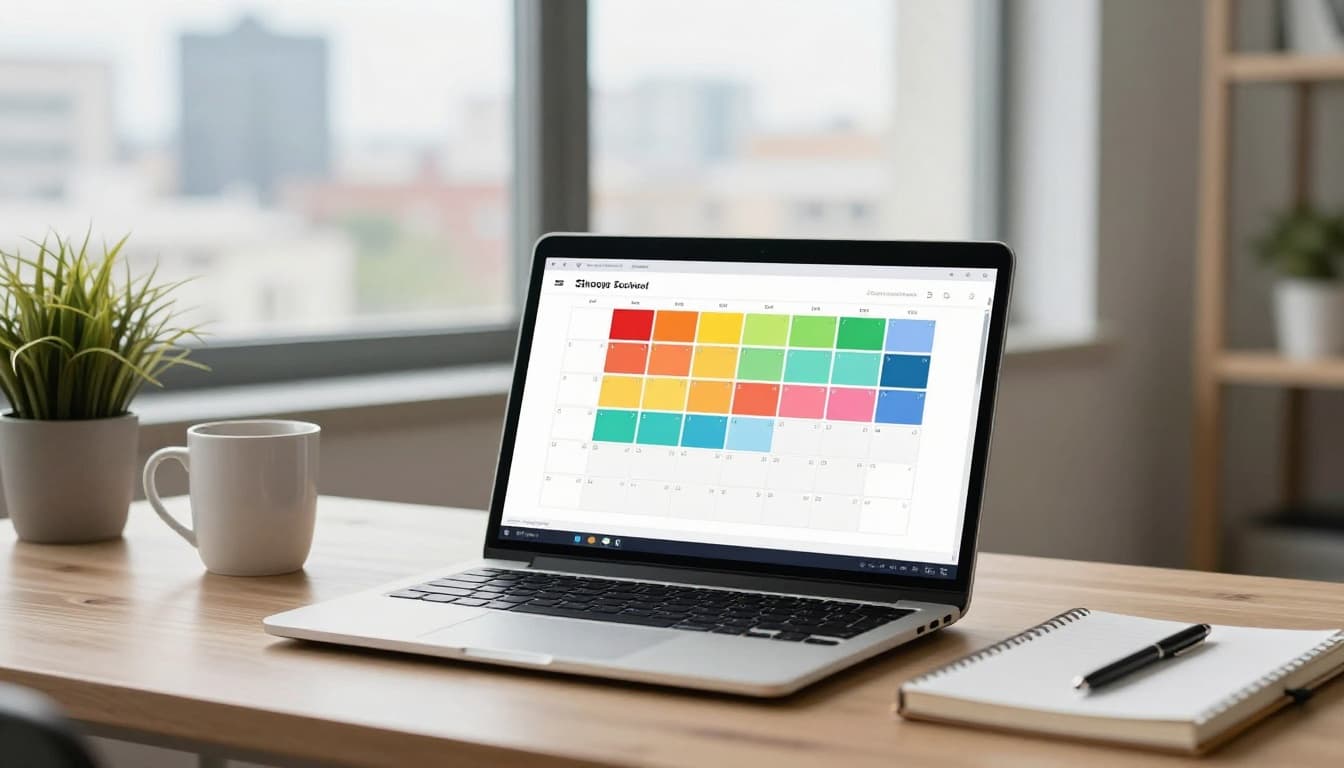 An example of a calendar designed for focus blocks, shorter meetings, and recovery breaks, created with AI.
Meetings are not free. They're a tax on attention.
Adopt a small set of rules you actually enforce:
- Default to 25 or 50 minutes, not 30 or 60
- Agenda required, otherwise the meeting doesn't happen
- Invite fewer people by default, observers are optional, not automatic
- Protect no-meeting blocks for deep work (and keep them sacred)
End every meeting with "decision or done." That means a decision (or clear next step), a single owner, and a timestamp. If you can't produce that, you held a discussion, not a meeting.
Also, add calendar blocks for recovery breaks. Not a full hour. A short buffer. This is where performance comes from.
Protect off-hours so people can actually recover
Always-on culture turns into a slow leak. People don't notice until the tank is empty.
Set expected response windows. Use status indicators. Encourage delay-send. Limit after-hours email. Most importantly, model it.
A simple policy many teams can handle: no internal messages after 6 pm local time unless it's a true incident. If leaders break the rule, the rule is fake.
When boundaries become normal, recovery becomes possible. That's the point. Burnout is often a recovery debt, not a work ethic issue.
Build recovery into the day so stress does not stack up
 Micro-recovery during the workday helps prevent stress from piling up, created with AI.
Most companies treat recovery like a weekend problem. Or a PTO problem. Or a "try yoga" problem.
That's too late.
Burnout builds inside the day, because stress stacks. Meeting to meeting. Task to task. Ping to ping. If you never downshift, your nervous system stays stuck in high gear.
Micro-recovery fixes that. Short breaks that fit real schedules. No training. No ceremony.
Guided breathing is one of the fastest options because it works directly on stress physiology. It's not spiritual. It's regulation.
Use 3 to 5 minute resets between meetings (the fastest win)
Use a tiny routine that people can repeat without thinking:
Stop.
Breathe slowly for a few minutes.
Drop your shoulders.
Then start the next task.
Pair it with triggers. After a hard meeting. Before a presentation. When switching projects. Those are the moments stress spikes, and the reset pays off.
If your team wants help making the reset automatic, Download Pausa. It's a guided breathing app built for real life, especially for people who don't want long meditations. The product came out of a simple need: after panic attacks, the founders looked for tools that worked fast, without turning wellness into homework. Short sessions. Clear direction. Less noise.
Also, it's designed to reduce screen time, not steal it. That alone makes it rare.
Offer team-wide tools that people will actually use
Wellness programs fail for predictable reasons. They ask for too much time. They require training. They feel performative. So people ignore them.
Low-friction beats "comprehensive."
Pausa Business is built around that idea: guided breathing that works from day one, on iOS and Android. It also includes AI-powered mood tracking, so the app can recommend breathing techniques based on how someone feels (stress, focus, energy, calm). In practice, that matters because people don't need to guess what to do.
Two more adoption levers help: a short 10-day breathing journey for beginners, and streaks that make habits stick as a team. Not through shame. Through small shared wins.
For leaders, the reporting can stay respectful. Engagement data can be fully anonymized, so you can see patterns without turning wellbeing into surveillance.
Pricing is simple too. Plans commonly start around $2 per employee per month (pricing varies by plan and scale). That's cheaper than most burnout "solutions," and it fits the real constraint: you don't have budget for another big program.
If you're worried about rollout friction, check supported iOS and Android versions so you know what devices your team can use.
Make burnout prevention part of your management system
Burnout doesn't get solved once. It gets managed, like cash flow.
So move from "initiative" to operating rhythm. Standardize a few habits. Review a few signals. Stop doing what doesn't work.
If you want a reminder of how expensive burnout gets, Onrec's 2026 overview of the hidden cost of employee burnout lands the point: burnout drains performance quietly, then shows up loudly as turnover and missed outcomes.
Train managers to spot early signs and respond with real changes
Early signs tend to look boring before they look dramatic:
Chronic fatigue. Irritability. Withdrawal. More errors. Missed deadlines. "Always busy" messaging. Low engagement in meetings. Short replies. No initiative.
Don't treat these as attitude problems. Treat them as load signals.
Your manager response should be empathy plus action:
Clarify the week's priorities. Remove tasks. Adjust deadlines. Rotate high-stress duties (on-call, escalations, customer fires). Encourage time off, then protect it. Most of all, stop rewarding martyr behavior.
If "hero mode" gets praised, you will get more hero mode. Then you'll get a crash.
Track a few simple signals to prove it is working
Use a lightweight scorecard. Here's a simple version that doesn't require new software:
| Signal to track | What it tells you | Direction you want |
|---|---|---|
| After-hours message volume | Boundary health | Down |
| Meeting hours per person | Interruption load | Down |
| PTO taken | Recovery reality | Up |
| Self-reported stress (quick pulse) | Human signal | Down |
| On-time delivery rate | System stability | Up |
Run a monthly 15-minute review. Pick one change to keep, one to improve, and one to stop. That's it. The point is momentum, not perfection.
Conclusion
Reducing burnout without hiring comes down to three levers: diagnose the real drains, redesign work to cut overload and interruptions, and build micro-recovery into the day so stress doesn't stack. Start with two changes this week, then measure what shifts.
Next step: pilot a two-week burnout reduction sprint with one team. Clean up meetings, cap WIP, and protect off-hours. Then add a simple breathing tool like Pausa Business so daily stress relief becomes normal, not exceptional.

