Slack pings stack up before the first sip of coffee. Meetings run back-to-back. Someone asks for "a quick favor," and you notice your breathing get smaller, higher in your chest, like your body's trying to hide.
That's how burnout sneaks in. Not as one dramatic collapse, but as emotional exhaustion, growing cynicism, and a slow drop in performance. People still show up, yet they're running on fumes.
Leaders can reduce burnout by fixing two things at once: the signals that create overload, and the recovery that helps people reset. Active breathwork matters here because it can change how the body responds to stress in minutes, no retreat required. This is for CEOs and decision makers who want real adoption, not another wellness tool that gets ignored.
 An overloaded work moment where stress shows up in posture and breath, created with AI.
Spot burnout early, before it shows up in mistakes and turnover
Workplace stress isn't abstract. It turns into missed details, slower decisions, and more "small" conflicts that drain teams. Over time, it also feeds churn, because the best people usually have options.
The problem is timing. Most leaders notice burnout when output drops, or when someone quits. Earlier signals are quieter, but they're visible if you know where to look.
Here's a simple check-in you can use this week:
- Energy: Are people starting the day tired, not just ending it tired?
- Tone: Is sarcasm replacing curiosity in meetings?
- Friction: Are small requests triggering big reactions?
- Rework: Are "easy fixes" showing up again and again?
- Recovery: Are lunch breaks disappearing, replaced by scrolling?
This article isn't medical advice. If someone's struggling deeply, encourage professional support. A breathing tool can help, but it can't replace clinical care when it's needed.
The signs leaders miss first (and what they look like day to day)
Burnout often looks like a personality change. The calm engineer snaps in code review. The friendly support rep goes quiet on calls. The top sales closer suddenly avoids prospecting, then overworks late at night to "catch up."
Watch for three clusters:
Behavior clues: shorter temper, withdrawal, more "I'm fine" responses, less initiative.
Body clues: tight jaw, headaches, shallow breathing, worse sleep, more caffeine to feel normal.
Work clues: rising cycle time, more handoffs, lower creativity, more mistakes that feel unlike the person.
"In the wild," it can be painfully ordinary:
- Support: rushing through tickets, then getting flooded by follow-ups.
- Engineering: shipping more code, but introducing more bugs and rework.
- Sales: pushing harder on volume while avoiding tough conversations.
When you see patterns like this, don't start with blame. Start with recovery and workload signals, because the nervous system usually tells the truth before the metrics do.
Stress vs anxiety vs burnout, a quick plain-English map
These terms get mixed together, which makes action messy. Here's a clean map you can share with managers.
| State | What it feels like | What tends to help fast | What needs system change |
|---|---|---|---|
| Stress | "Too much, too fast" | Short recovery breaks, clearer priorities | Better pacing, fewer collisions |
| Anxiety | "Something bad might happen" | Breathwork to downshift, grounding | Support, predictability, sometimes therapy |
| Burnout | "I can't keep doing this" | Micro-recovery plus real boundaries | Workload, control, time to recover |
Breathwork can help with stress and anxiety signals in the moment. Burnout also needs structural fixes, because you can't breathe your way out of a broken workload forever.
Why active breathwork can calm stress quickly (without long meditation)
The body has a stress gear and a calm gear. Breathing is one of the few switches you can reach on purpose.
When stress hits, many people breathe faster and shallower. The brain reads that as danger, even if the "danger" is just a hard email. Slowing the breath, especially the exhale, can help the body shift toward calm. A steady rhythm also supports focus, because attention follows physiology.
Research is still evolving, but there's meaningful evidence that breathwork supports stress reduction. A meta-analysis of randomized controlled trials found breathwork was associated with improvements in stress and mental health outcomes across studies, although methods vary and results depend on the approach and setting (see the breathwork meta-analysis of randomized trials).
For busy teams, the key is format. Short, guided sessions remove friction. That's the idea behind Pausa: science-informed breathing patterns, guided with audio, designed for real life, and useful from day one.
 A quick reset that fits into a workday without a special room, created with AI.
What "active" breathwork means at work, short, guided, and repeatable
Active breathwork isn't just "relax." It's a deliberate pattern that nudges the nervous system in a direction. Think of it like adjusting the tempo of a song, your body follows.
Work-friendly options include:
- Box breathing (steady nerves): useful before a presentation, a tough call, or a high-stakes decision.
- Resonant-style steady breathing (calm focus): a smooth rhythm that helps you feel more centered during deep work.
- Downshift breathing (longer exhales): helpful after conflict, when your body still feels "lit up."
- Energizing breathing (gentle, brief): can help during the 2:30 pm slump, but it should feel controlled, not extreme.
Evidence for coherent or steady breathing continues to grow. One randomized placebo-controlled trial reported mental health and wellbeing benefits from coherent breathing practice, though outcomes vary by population and protocol (see the coherent breathing randomized trial).
If anyone feels dizzy, uncomfortable, or panicky during breathwork, they should stop and return to normal breathing. People with health conditions, pregnancy, or a history of fainting should check with a clinician before trying intense techniques.
The goal at work isn't intensity. It's reliability.
The real advantage, it fits into micro-breaks your team will actually take
Most wellness tools fail because they ask for too much: too much time, too much quiet, too much new behavior. Teams don't ignore them because they don't care. They ignore them because they're busy.
Breathwork can slide into the cracks of the day. Two minutes between meetings. Three minutes after a heated customer escalation. A short reset before writing, reviewing, or negotiating.
Also, it meets people where they are. Not everyone wants to meditate. Everyone already breathes. That one fact changes adoption, because the "entry skill" is built-in.
A simple anti-burnout plan leaders can run in 30 days
A month is long enough to create a new team reflex, and short enough to keep urgency. The plan below pairs system signals (workload and boundaries) with fast recovery (breathing moments).
Start with a baseline: ask teams to rate end-of-day stress twice a week for two weeks. Keep it anonymous. Then run a 30-day pilot and compare.
If you want implementation ideas grounded in research and practice, a systematic review offers practical guidance on how breathing practices can be introduced and supported (see implementation guidelines from a breathing practices review).
Create "breathing moments" in the calendar, before stress spikes
Don't wait for people to remember. Put recovery where stress tends to build.
A simple weekly cadence can look like this:
- Meeting start (2 minutes): begin with a short guided breath to settle attention.
- After hard calls (3 minutes): a decompression breath to drop the adrenaline.
- End-of-day (3 minutes): a downshift to reduce "work follows you home" energy.
Managers worry it'll feel awkward. It won't, if you model it like any other work norm: brief, optional, and consistent. Use plain language. "Let's take two minutes to reset, then we'll start."
To make this easy for employees, point them to a guided option they can open immediately. Share the app link in your rollout materials: download Pausa in English (Spanish version: Pausa en español).
Small note that matters: keep it opt-in at first. Compliance kills trust.
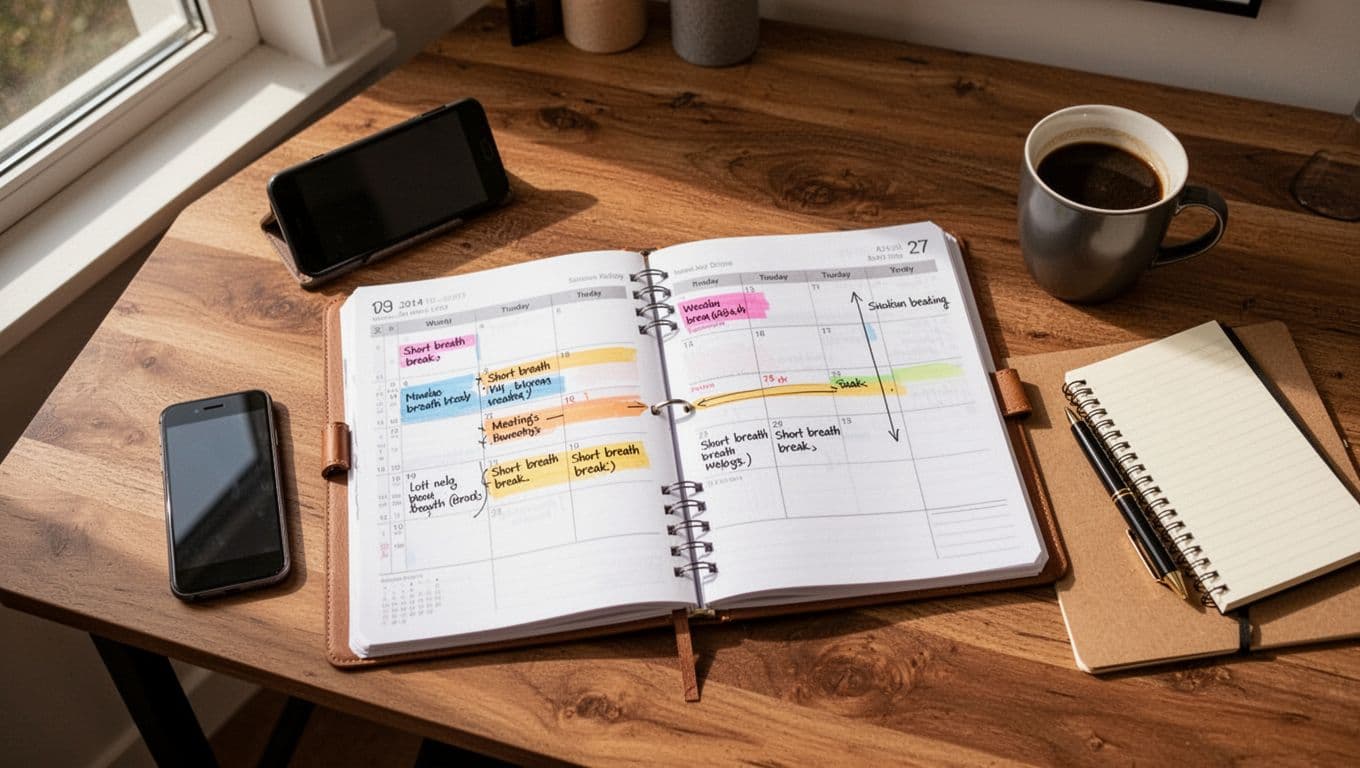 Planning recovery like a real work block, not a "nice if it happens," created with AI.
Make it stick with tiny habit loops, streaks, and a 10-day on-ramp
Burnout prevention lives or dies on habit. People don't need motivation, they need a loop.
Keep it simple:
Cue: a trigger you already have (meeting starts, laptop opens, call ends).
Action: a 2 to 5-minute guided breath.
Reward: immediate relief, plus the satisfaction of completion.
A short "on-ramp" helps beginners stop overthinking. A structured 10-day journey can take someone from "I don't do this stuff" to "I know exactly what to do when I'm tense." Streaks can also help, as long as you frame them as encouragement, not a scoreboard. The tone should be, "Nice job taking care of yourself," not "Why did you miss a day?"
Measure what matters without invading privacy
Leaders want proof. Employees want safety. You can have both.
Track adoption and outcomes at a team level, not an individual level. Use lightweight measures:
- self-reported stress trending down
- focus trending up
- fewer late-night messages
- fewer "everything is urgent" escalations
- fewer sick days over time (as one signal, not the only one)
AI-powered mood tracking can also help recommend breathing techniques for calm, focus, or energy. The ethical line is clear: explain what's collected, keep it anonymized, and never use it for performance management.
Say it out loud in writing: wellness data won't be used to rank, punish, or target people. Trust is the fuel for adoption.
How Pausa Business helps teams breathe together, with zero training
Pausa was built for real stress, including the kind that follows panic attacks. That origin shows up in the product's tone. It feels like companionship, not homework.
For organizations, Pausa Business works as a B2B2C model: the company buys access, colleagues download the app on iOS or Android, and they start with short guided sessions right away. No workshops required for basic use, although teams can add them if they want.
This approach fits what leaders care about: adoption. Pausa Business is designed to be used without extra training, and it offers anonymized reporting so you can understand engagement without exposing individuals. Pricing is straightforward too, starting around $2 per employee per month (with annual options available).
What you roll out, and what employees feel in week one
From the employee side, the first week should feel simple: open the app, choose how you feel, press play, breathe.
That flow matters because stress doesn't wait for onboarding. Pausa's guided breathing patterns support common work states like stress, anxiety, low energy, and lack of focus. It also includes nudges that reduce screen time, like gentle "unlock to breathe" prompts that redirect scrolling into a short pause.
There's also a practical benefit that leaders often miss: when people learn a fast reset, conflicts shrink. Not because teams avoid hard topics, but because the body isn't stuck in fight-or-flight during every disagreement.
A study in Scientific Reports even tested resonant breathing in a simulated office environment and found improvements in stress recovery signals, which supports the idea that breathing tools can fit real work contexts (see the resonant breathing office study).
 A team using a short breathing reset as a meeting norm, created with AI.
A practical rollout checklist for CEOs and People leaders
Keep the rollout boring. Boring scales.
Pick a pilot group, then set two clear team norms: a short breath at the start of meetings, and a reset after high-stress incidents. Announce your privacy stance in writing. Next, appoint one champion per department to model the habit, not police it.
Finally, review engagement weekly using anonymized insights, then expand.
Pausa Business also offers an admin panel to manage licenses and view engagement and wellness reports in one place (see the Pausa admin panel). That matters when you want to support a habit across teams without turning it into another manager task.
Conclusion
Picture the same workday, but with softer edges. Meetings start with steadier voices. Hard feedback lands without sparks. People still work hard, but they recover in small, repeatable moments.
The core message is simple: fix the systems that overload teams, then add fast recovery so stress doesn't pile up. Make active breathwork the default micro-break, because it fits real calendars.
Pilot a 30-day program, and pick one moment today to start, ideally before the next meeting. If someone on your team is struggling in a deeper way, encourage professional support alongside any breathing practice.

