Your shoulders creep up toward your ears. Your jaw stays clenched. You open your inbox and feel a small wave of dread, even before you read a word.
That's workplace burnout in its early costume: your body on alert, your mind trying to push through anyway.
The good news is that breathing exercises for workplace burnout can help fast. Not as a cure for a broken workload, but as a way to steady your system so you can think clearly again. In this guide, you'll learn simple breathing resets you can do at your desk in about five minutes, even on a packed day.
Slow, steady breathing is like telling your nervous system, "I'm safe right now." When that message lands, your heart rate often eases, tension softens, and your next choice gets easier.
Spot burnout early, so you can interrupt it before it snowballs
 An overwhelmed moment at the desk, the kind that often comes right before burnout shows itself, created with AI.
Burnout isn't just "being tired." In plain terms, it's a long stretch of stress where your energy runs low, your patience runs thin, and work starts to feel pointless. Many people also notice cynicism, detachment, or that numb, robotic feeling in meetings.
It helps to name what's happening, because burnout often grows quietly. At first it looks like "I'll just power through this week." Then weeks stack up. Soon, small tasks feel heavy.
Breathing won't fix unrealistic deadlines or a toxic culture. Still, it can give you something valuable: a steadier body and a clearer head. From that steadier place, you're more likely to set boundaries, ask for help, take breaks, and make changes that actually reduce burnout.
The 5 signs your body is stuck in stress mode
Burnout has a mental side, but it often shows up through the body first. Watch for these quick markers during the workday:
- Shallow chest breathing, like you can't get a full breath
- Jaw clenching or teeth grinding
- Tight chest or a "wired" feeling in the ribs
- Faster heart rate, even while sitting still
- Brain fog, like your thoughts are wading through mud
- Irritability that surprises you
- Trouble sleeping, especially racing thoughts at night
Here's a 10-second self-check you can do without anyone noticing: feel where your breath is landing. Is it high in the chest? Then drop your shoulders once. Unclench your jaw. Exhale slowly. That exhale is your first tiny exit ramp.
Why a few slow breaths can change your next hour
Stress speeds breathing up and pulls it higher into the chest. That pattern keeps your body ready to react. Slow breathing does the opposite. It nudges your system toward "rest and digest," the calmer state where focus and steady decision-making come back online.
Recent research keeps pointing in the same direction: breathing practices can reduce stress and anxiety for many people, often with short sessions. For example, a 2025 study in a simulated office setting found resonant breathing with guidance supported stress recovery, measured through both body signals and self-report. If you like the details, see this resonant breathing office study.
Another benefit matters at work: breathing can be social in a good way. A short group pause before a tough meeting can shift the room. People speak more slowly. Faces soften. The temperature drops, without anyone needing to "talk about feelings."
A five-minute breathing reset doesn't erase the cause of burnout, but it can change how your body meets the next hour.
Four quick breathing exercises you can do at your desk (no special gear)
 A desk-friendly breathing posture that looks normal in an office, created with AI.
Before you start, a quick safety note: if you feel dizzy, lightheaded, or strained, stop and return to normal breathing. Keep your inhales gentle. You're not trying to win anything.
Also, watch the three most common mistakes: lifting the shoulders on every inhale, forcing huge breaths, and holding longer than feels comfortable. Smooth and easy beats big and intense.
If you want a broader explainer on how breathwork affects stress, this overview is useful: how breathwork supports stress reduction.
Diaphragmatic breathing, the reset button for overwhelm
This is belly breathing. It's the simplest "back to baseline" tool when you feel scattered, tense, or close to snapping.
Sit back in your chair and place one hand on your belly, the other on your chest. Keep your shoulders heavy.
Inhale through your nose and aim the breath low, so the belly rises under your hand. Then exhale slowly, as if you're fogging a mirror, but with lips closed if possible. Let the exhale last a little longer than the inhale.
Do this for 3 to 5 minutes.
A desk-friendly tip: keep your feet flat and your spine tall, but not stiff. When your ribs can move, your breath has room. When your belly can soften, your mind often follows.
Resonant breathing (5-5) for steady calm during chaotic days
Resonant breathing is a simple rhythm: inhale for about 5 seconds, exhale for about 5 seconds. You don't need a timer if it stresses you out. Just count softly in your head.
Try it when your day feels choppy, like you keep getting pulled into fires. This pattern often feels smoother than breath holds, so it works well for beginners and for people who already feel on edge.
Stay with it for 5 minutes, or do 10 cycles if you're short on time.
If you notice yourself taking "extra" breaths, that's okay. Don't fight your body. Just return to the rhythm and keep the exhale unforced.
Box breathing for sharp focus before tough moments
Box breathing uses equal counts on all four parts of the breath:
Inhale, hold, exhale, hold.
Start with 4-4-4-4. If that feels too strong, use 3-3-3-3. If it feels easy, you can move up slowly over time.
Use this before presentations, hard emails, performance reviews, or any moment where your emotions want to sprint ahead of your words. The holds add structure, which many people find grounding.
One key adjustment: keep the inhale calm. Box breathing isn't meant to feel like gulping air.
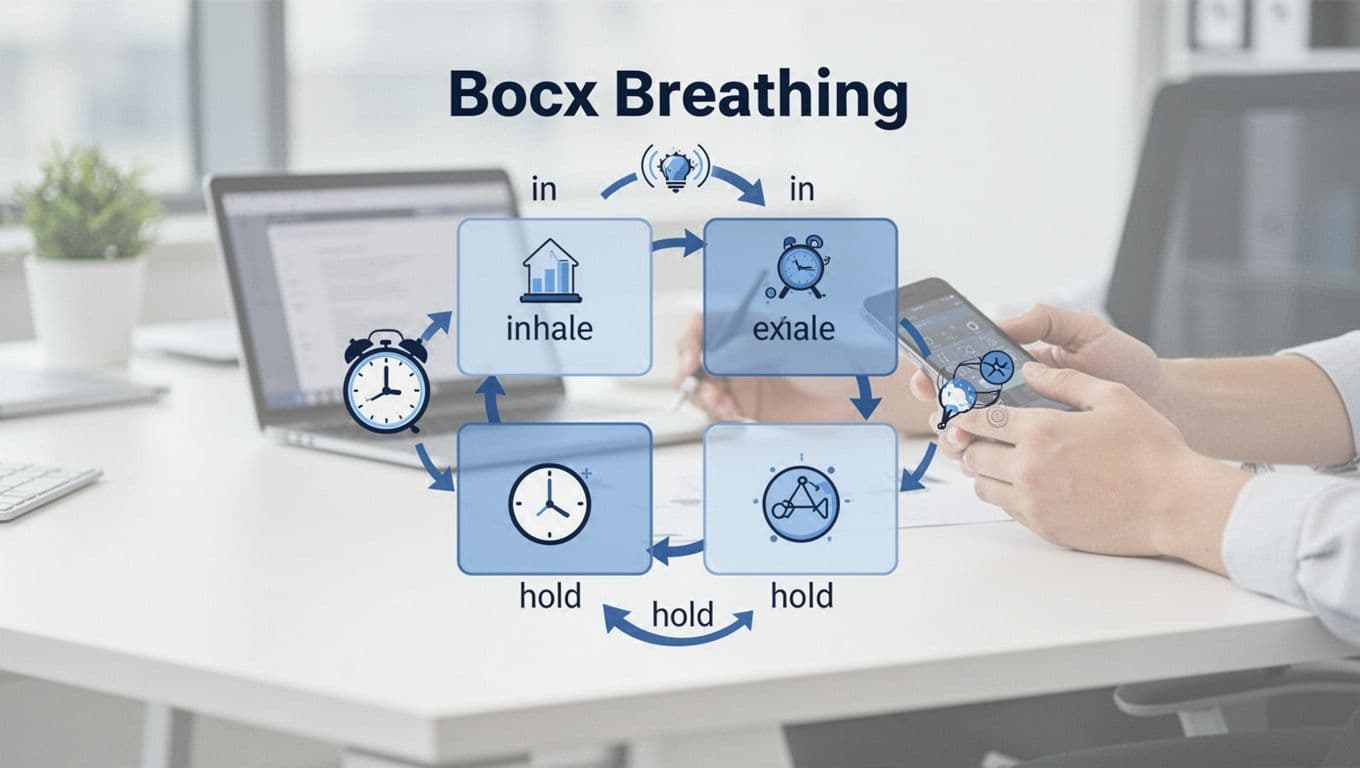 A simple visual for the inhale-hold-exhale-hold cycle, created with AI.
4-7-8 breathing for end-of-day tension and racing thoughts
When burnout ramps up, evenings can feel strange. Your body is exhausted, but your mind keeps running.
4-7-8 breathing can help you downshift. The pattern is:
Inhale through the nose for 4, hold for 7, exhale for 8.
Do 3 to 4 rounds, then stop. More isn't always better, especially at first.
Keep the inhale gentle. If the hold feels too long, shorten it. The point is a slow, extended exhale, because longer exhales often help the body settle.
This one fits well after work, before bed, or right after you close your laptop and feel that leftover buzzing in your chest.
Make it stick at work, without turning self-care into homework
 A short team breathing moment that can shift the tone of a meeting, created with AI.
Burnout loves chaos and inconsistency. It grows when every day feels like you're starting over. That's why the goal isn't perfect breathing. The goal is a tiny routine that survives real workdays.
Think of it like brushing your teeth. You don't wait for the "right mood." You do a small thing, often enough, and the benefits pile up quietly.
If you like learning through short reads, you can also browse the Pausa breathing and stress blog for practical guides on calm, focus, and sleep.
A simple 3-point plan, morning, midday, after meetings
This plan is small on purpose. It should feel almost too easy.
First, take 1 minute after you log in. Do diaphragmatic breathing and soften the shoulders. Starting calm doesn't guarantee a calm day, but it helps.
Next, do 3 minutes before lunch. Use resonant breathing (5-5). It's a clean reset before the afternoon push.
Finally, take 2 minutes after a stressful meeting. Choose box breathing if you need focus, or 4-7-8 if you feel wired.
Consistency beats intensity here. If you miss a day, you haven't failed. You're just human. Pair the pause with something that already happens, coffee, washing your hands, closing a tab, or plugging in your laptop.
Try guided breathing when you are too tired to think
Burnout comes with decision fatigue. Even "pick a breathing method" can feel like one more task.
Guided breathing helps because you can stop thinking and start following. That's the idea behind Pausa, a mobile app built around simple, science-backed breathing sessions for stress, focus, energy, and calm. It was created after the founders experienced panic attacks and wanted something that worked in real moments, without long meditations.
If you're practicing solo, guidance can feel like companionship. If you're practicing with a team, guidance can help everyone follow the same rhythm without awkwardness.
Features that can make workplace habits easier include:
- Mood-based recommendations that suggest a breathing pattern based on how you feel
- A 10-day learning journey that teaches techniques in small daily steps
- Streaks that turn "I forgot again" into "I'm building something"
- Short sessions that fit between meetings, not just at sunrise
On the work side, research on digital mental health tools suggests structure and usability matter for adoption. If you want the academic angle, this systematic review and meta-analysis on workplace digital mental health digs into what tends to help interventions succeed.
Use breathing as part of a bigger burnout recovery plan
Breathing works best when you treat it like a stabilizer, not a solution to everything. It's the thing you do so you can take the next right step.
That next step might be setting a boundary, asking for clearer priorities, or taking real time off. It might also mean talking to a clinician, especially if burnout is tangled with anxiety, depression, panic symptoms, or persistent sleep loss.
If you feel unsafe, hopeless, or unable to function, get professional help right away. You deserve support that goes beyond tips.
What breathing can do fast, and what it cannot fix alone
Here's the honest split:
Breathing can help quickly by lowering the body's alarm signals. You may notice fewer stress spikes, a calmer heart rhythm, and less emotional snap. Many people also find it easier to focus after even a few minutes.
Still, breathing can't solve a workload that never ends. It can't repair unclear roles, constant after-hours pings, or a culture that rewards burnout. Those problems need action, and often they need other people involved.
A helpful mindset is "both, not either." Use breathing to steady yourself, then use that steadiness to make changes. If you want a wider view of workplace stress supports, including the role of compassion and social support, this systematic review on worker stress interventions offers useful context.
Conclusion
Burnout can feel like you're stuck under a heavy coat you can't take off. Still, one slow exhale can be the first loosened button.
Try one of these today: diaphragmatic breathing for overwhelm, resonant breathing for steady calm, box breathing for focus, or 4-7-8 for racing thoughts. Pick one and practice for five minutes in the next 24 hours. Notice what shifts, even if it's small, then repeat tomorrow.
Your next breath is already waiting. Make it a pause you can feel.

