Work stress isn't a soft problem. It's an error rate problem. It shows up as missed details, sharper emails, slower decisions, and people quietly updating their resumes.
In 2026, surveys keep saying the same thing in different ways: burnout is common, stress is high, and a lot of teams are running hot for too long. That heat turns into churn. It also turns into presenteeism, the kind where someone shows up but isn't really there.
Breathwork for workplace wellbeing is not a cure-all. It's better than that. It's a simple input that changes the nervous system's output fast, without turning your workday into a retreat. No incense. No 45-minute meditation. Just a short, repeatable "reset" your people can do between real meetings.
This guide explains why it works, which techniques fit work moments, and how to roll it out without making it awkward. If you want a guided option, Pausa is one lightweight way to support daily breathing habits at scale, but the core skill matters more than the tool.
Why breathwork works for workplace wellbeing (and why it beats "just be resilient")
 An office moment that shifts from tension to calm, created with AI.
Most workplace stress advice is moral pressure in disguise. Sleep more. Be resilient. Practice gratitude. Fine, but none of that helps when your heart is racing before a client call.
Breathwork works because breathing is one of the only body systems you can steer on purpose that also steers you back. Change the breath; you change the signal your brain reads as "safe" or "threat." That signal changes attention, impulse control, and tone in conversation.
The research is moving from "interesting" to "useful." A large meta-analysis of randomized controlled trials found breathwork is linked with meaningful drops in self-reported stress and improvements in mental health outcomes compared with control conditions, summarized in Scientific Reports' breathwork meta-analysis. Meanwhile, more recent reviews keep pointing in the same direction: slower breathing patterns are associated with higher heart rate variability (HRV), a marker often used as a proxy for stress tolerance and recovery capacity. You can see that theme in the 2025 evidence base on breathing practices in Frontiers' pranayama systematic review.
None of this requires belief. It requires repetition.
Breathwork isn't "wellness." It's nervous system regulation you can run on demand, like a manual override.
One guardrail: breathing exercises are not a replacement for clinical care. If someone has panic disorder, trauma, or a medical condition, they may need professional support. Breathwork can help many people feel steadier, but it shouldn't become a substitute for treatment.
The simplest model: change the breath, change the state
Your body runs two basic modes.
One is fight-or-flight. Fast breathing, tight chest, narrow focus, quick reactions. Helpful for danger; messy for Slack.
The other is rest-and-digest. Slower breathing, softer muscles, wider attention, better listening. Helpful for work that needs judgment.
Longer exhales and slower breathing tend to nudge the body toward the second mode. It's a "we're safe enough" message. Not perfect safety. Just enough to stop the spiral.
Two workplace examples make this concrete:
- Pre-presentation jitters: your mind is fine, but your body is acting like it's being hunted. Two minutes of paced breathing can lower the noise so you can speak.
- Post-meeting tension: you leave a tough discussion and keep replaying it. A short exhale-heavy practice can help you exit the loop before it becomes your whole afternoon.
What leaders should expect (and what not to promise)
Expect small wins that compound: fewer stress spikes, faster recovery, cleaner communication, and more stable focus. Also expect uneven adoption. Some people will love it. Some will ignore it. That's normal.
Don't promise it will fix toxic workloads. It won't. Breathwork is a regulator, not a workload optimizer. Pair it with basics that actually matter: role clarity, meeting hygiene, and manager training that reduces needless friction.
Also, protect psychological safety. Make it opt-in. Avoid spotlighting. Treat it like stretching, not confession. If you measure anything, keep it anonymous and aggregated. Surveillance kills participation.
Four breathwork techniques employees can use in 1 to 5 minutes at work
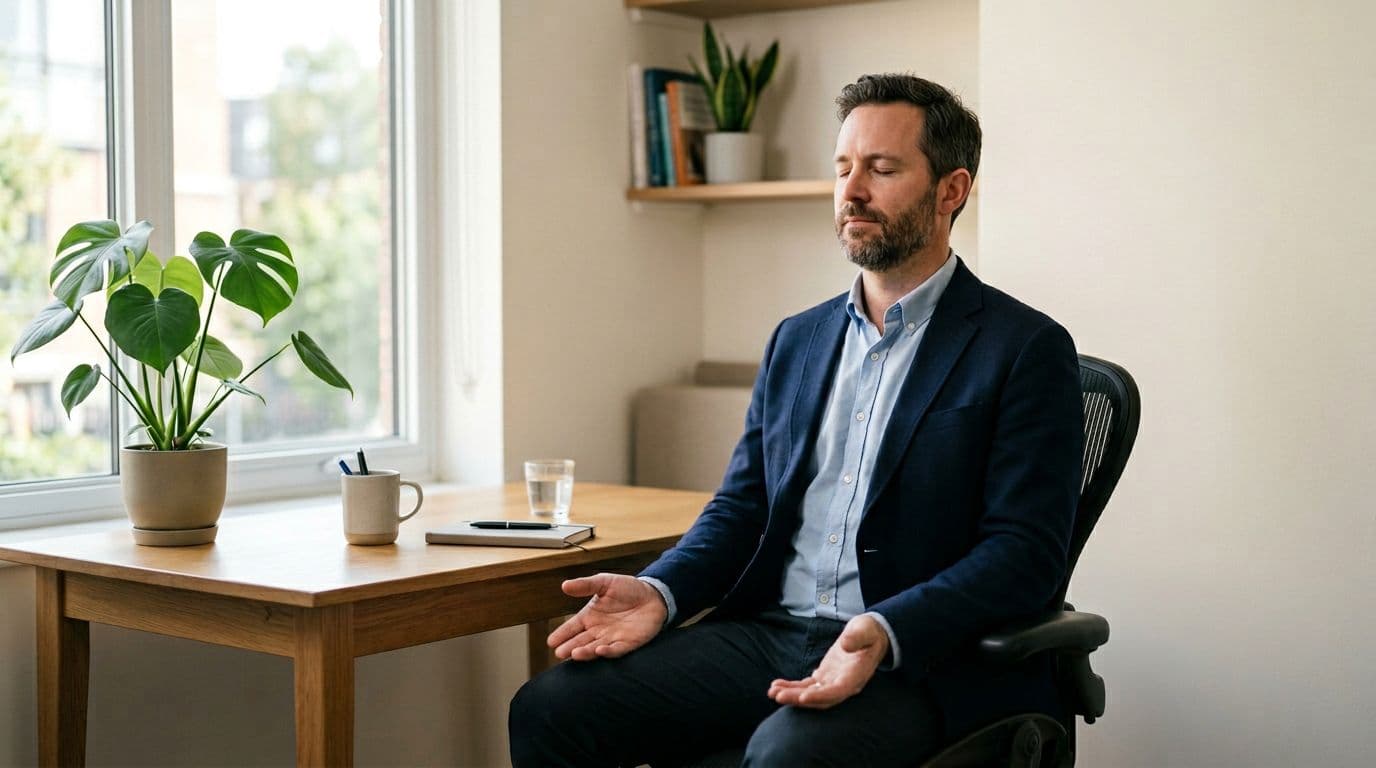 Quiet desk breathwork that fits a real workday, created with AI.
These techniques are meant to be quiet. No special posture. No props. Done at a desk, in a hallway, or before you re-open the laptop.
Safety notes, keep them simple: if someone feels dizzy, they should stop and breathe normally. Keep the breathing gentle, not forced. Anyone with medical concerns should check with a clinician.
For broader background on how breath practices map to stress reduction, the overview in News-Medical's explanation of breathwork science is a solid starting point.
Box breathing for calm focus before a tough moment
When to use it: before a client call, before a performance review, after reading a stressful email.
How long it takes: 1 to 5 minutes.
Cue to remember: "Four sides of a box."
Steps (4-4-4-4):
Inhale through the nose for 4 seconds.
Hold for 4 seconds.
Exhale for 4 seconds.
Hold for 4 seconds.
Repeat for 4 rounds if you're short on time. If you can spare it, run 3 minutes. Box breathing is structured, which is why it works in messy moments. It gives your attention a rail to ride on.
The physiological sigh for instant stress relief when pressure spikes
When to use it: after conflict, right before walking into a meeting, when your chest feels tight.
How long it takes: 30 to 60 seconds.
Cue to remember: "Two in, one out."
Steps (cyclic sighing):
Inhale through the nose.
Top it off with a second, short inhale (same breath).
Exhale slowly and fully through the mouth.
Repeat 3 to 5 times. Keep it steady. The point isn't drama. The point is a fast downshift.
If you want to make this easy for employees who don't like memorizing steps, a guided app can do the counting. Pausa was built for those short "use it now" moments, and you can point teams to Pausa's guided breathing app as a simple option.
4-7-8 breathing to downshift and unwind after work (or after late meetings)
When to use it: end of day, post-travel, after late meetings, or when sleep is hard.
How long it takes: about 2 minutes.
Cue to remember: "Long hold, longer exhale."
Steps (start gently):
Inhale through the nose for 4 seconds.
Hold for 7 seconds.
Exhale slowly for 8 seconds.
Do 4 cycles. This can feel strong for some people. That's why it's usually better after work, not right before you have to present. If the hold feels like too much, shorten it. You're not trying to win breathing.
Resonance breathing for steady energy and better stress tolerance over time
When to use it: a daily reset, between blocks of deep work, or as a routine before the day starts.
How long it takes: 5 minutes.
Cue to remember: "Slow and even."
Breathe at about 5 to 6 breaths per minute. That's roughly a 5-second inhale and a 5-second exhale, sometimes with a slightly longer exhale. The goal is smoothness, not depth.
Why this matters: slow, paced breathing is often linked with higher HRV in research discussions, which is one reason it gets framed as a "recovery" practice. It can also improve mood in controlled settings, even in short doses. Over time, the real payoff is simpler: you recover faster from normal stress.
Put it on the calendar if you want it to happen. Or use a guided timer so nobody has to count in their head.
How to roll out breathwork at work without making it awkward (or ignored)
 A meeting room "pause" that feels normal, not performative, created with AI.
Adoption fails for one boring reason: friction. Too many steps. Too much hype. Too much social risk.
So keep it plain. Make it optional. Put it where stress already happens.
Breathwork fits naturally in three places:
- Meeting openers: 30 to 60 seconds before the first agenda item. It reduces cross-talk and rush.
- Post-incident resets: after an escalated customer call or a tense internal sync. It shortens the emotional hangover.
- Focus blocks: before deep work, especially after context switching.
If you want evidence that technique choice matters less than consistency, this review helps frame it: MDPI's discussion of technique differences in breathwork. Translation for leaders: pick a few patterns, then make doing them easy.
For teams that want an organized, low-lift system, Pausa for Business is built around that reality. The company buys access, colleagues download the app on iOS or Android, and guided sessions work from day one with no training. Reporting is anonymized, which matters if you want honest engagement. Pricing starts around $2 per employee per month (or annual equivalents). Leaders can also manage licenses and see high-level engagement through an admin panel, without turning wellbeing into monitoring.
The features are designed for stickiness without pressure: AI-powered mood tracking that suggests a matching breathing technique, a 10-day journey that builds skill step-by-step, streaks that turn practice into a shared habit, and screen-time nudges that interrupt doomscrolling with a short breathing pause. That last piece matters more than it sounds. Phones are often the stress amplifier sitting in everyone's pocket.
Start small: one shared "pause" per day beats a big wellness launch
Skip the grand announcement. Run a two-week pilot that feels normal.
Two-week pilot plan:
- Add 60 seconds of box breathing to the start of one recurring team meeting. Same meeting, every time.
- Offer an optional 3-minute reset after intense meetings (customer escalations, staffing decisions, conflict resolution).
- Encourage individuals to pick one personal cue, for example "after I hit send" or "before I join Zoom."
- At the end of week two, ask what changed. Keep it short. Keep it anonymous.
Sample leader script that doesn't try too hard:
"We're going to take 60 seconds to breathe before we start. Opt in if you want. Cameras can stay however you like. This is just a reset so we're not bringing the last meeting into this one."
That's it. No sermon. No forced vulnerability.
Make it safe and measurable: anonymity, opt-in, and lightweight metrics
You can measure impact without peeking into anyone's private life. Use team-level signals. Keep them boring.
Five practical metrics that don't create fear:
- Participation rate: how many join the shared pause (count heads, not names).
- Self-reported stress: a one-question pulse, weekly, anonymous.
- Focus rating: "How focused did you feel this week?" simple scale.
- Meeting quality: shorter meetings, fewer repeats, less rehashing.
- Retention or absenteeism signals: trends over time, not instant proof.
If you want a deeper research-oriented framing on breath-based methods and resilience, this narrative review is a useful scan: PMC's review of breathwork and stress resilience.
The rule is consistency: measure the same way, at the same cadence, then decide. Not after three days.
Conclusion
Stress will keep showing up at work. That part isn't optional. What's optional is letting it run your team's operating system.
Breathwork is fast, low-cost, and practical. It helps people recover quicker, think clearer, and communicate with less heat. Still, it works best when leaders remove friction, model the behavior, and stop pretending breathing can fix broken workloads.
The next step is simple: pick one technique, run a two-week pilot, and keep it opt-in. If it sticks, scale it with guidance, whether that's a simple timer or a platform like Pausa and Pausa Business that helps teams build the habit without training or privacy risk. The goal isn't perfection. It's recovery on purpose.

