Stress at work isn't abstract. It shows up as sloppy emails, missed details, short tempers, and preventable rework. Then it turns into churn. You can call it "burnout" if you want, but the outcome is the same: people run hotter, longer, and break more often.
A corporate breathwork program for teams is one of the few wellness moves that can be both low-lift and real. Not a big culture initiative. Not a retreat. Just short, guided breathing that helps people settle their system fast, then get back to work with a cleaner mind.
Used well, these micro-sessions can support calm and focus during intense days, especially for employees who don't meditate and never will.
This is wellbeing support, not therapy, and it's not a replacement for clinical care. It's a simple reset button for the nervous system, available on demand.
What a corporate breathwork program for teams actually is, and what it is not
 Team members taking a short, guided breathing pause together (created with AI).
In workplace terms, breathwork is simple: guided breathing patterns that help employees shift out of fight-or-flight and back toward steady. Not "becoming your best self." Not "opening your heart." Just changing the input to the body's operating system.
A real program doesn't demand time. It borrows time from the gaps you already have.
What people actually do:
- 2 to 10 minutes before a high-stakes meeting.
- 3 minutes after a tense customer call.
- 2 minutes between back-to-back Zooms.
- 5 minutes during the mid-afternoon slump, when focus turns to mush.
- 60 seconds after a tough Slack thread, before typing something you'll regret.
That's it. Small windows. Repeatable moments. A consistent pattern that reduces friction.
What it is not:
- Not a long meditation class with incense energy.
- Not spiritual instruction.
- Not forced sharing, journaling, or group vulnerability.
- Not a performance ritual where people "prove" they're well.
- Not a substitute for therapy, medication, or professional mental health support.
The best programs are optional and boring in the right way. They aim for repeatable micro-practices, not one-time workshops that feel nice and vanish by Tuesday. That matches what many employers are prioritizing in 2026: practical habits that travel across hybrid schedules. For a snapshot of where corporate wellness is heading this year, see HealthFitness' take on top corporate fitness and wellness trends for 2026.
The business case leaders care about, stress, focus, and fewer bad days
Breathwork isn't magic. It's a constraint you place on physiology. Slow the breath down, and many people report the rest of the system follows.
That matters because stress doesn't just feel bad. It makes teams careless. It compresses attention. It narrows options. Under load, people choose the first workable answer, not the best one. Over time, that's how you get more "small mistakes" that cost real money.
Leaders also care about consistency. Not peak performance, just fewer crash days. Studies suggest controlled breathing can reduce perceived stress and improve mood, and many teams report clearer focus after short sessions. Keep the language honest: results vary, and no program fixes broken jobs. Still, breathwork can help people regulate enough to do the work they already have to do.
In 2026, the direction is clear. More hybrid-friendly wellness, more executive stress support, and more "do it in two minutes" tools that don't require a full lifestyle change. For a broad business-oriented view of why breathwork is being adopted at work, this article on breathwork and workplace performance captures how companies frame it: decision quality, leadership presence, and culture tone.
Common breathing methods used at work (simple, safe, and easy to teach)
Most corporate programs rely on a short list of patterns because they're easy to explain and easy to repeat.
- Box breathing: Inhale, hold, exhale, hold, all for equal counts. Useful before presentations or difficult conversations.
- Resonant breathing: A steady, slower rhythm (often around five to six breaths per minute). Good for sustained focus and calmer energy.
- Physiological sigh: Two short inhales, then a longer exhale. A fast way to "downshift" when the body feels revved up.
- Energizing breath: A quicker, controlled pattern to counter the afternoon dip (kept gentle, not aggressive).
- Extended exhale: Make the exhale longer than the inhale. Simple, and often effective for settling.
Set the safety rules upfront. Sessions should be optional, paced, and trauma-informed. People should be able to stop anytime, keep eyes open, or skip a hold. No pushing. No "powering through."
If a breathwork session feels like pressure, it failed. The point is regulation, not endurance.
How to design a breathwork rollout your team will actually use
 An employee taking a two-minute breathing reset at their desk (created with AI).
Most wellness rollouts fail for one reason: they add friction. They require training. They demand scheduling. They ask managers to become hall monitors.
A breathwork rollout should feel like zero training. People shouldn't need a manual. They should need a button.
Start with a pilot that fits real calendars:
- Pick one moment that already exists, like the first two minutes of a weekly team meeting.
- Make participation opt-in, with a clear "skip is fine" line from leadership.
- Use short defaults, like two to four minutes. Longer sessions can come later.
- Design for hybrid from day one, so remote employees are not second-class participants.
- Let leaders model it, but don't let them police it. Modeling builds safety. Policing kills it.
Then add breathwork where it actually helps:
- Start-of-meeting reset: Two minutes to lower background noise before decisions.
- Post-incident recovery: After an outage, escalation, or angry client call, do a short reset before the next task.
- Transition breaths: A short pattern between meetings so stress doesn't stack.
- Optional team challenges: Light, friendly, and never tied to performance reviews.
Also, don't ignore the social layer. People adopt faster when it feels normal, not when it feels like a self-help side quest. If you want examples and framing that avoid wellness theater, pull ideas from the Pausa Business blog on workplace wellness.
A practical note: many employees already use personal breathing apps when anxiety spikes, they just do it quietly. A corporate program brings that into the open without forcing disclosure. It turns private coping into a shared tool, with boundaries.
Pick the format: live sessions, self-guided app, or a hybrid
You don't need to guess. Each format has strengths, and the tradeoffs are predictable.
Here's the simplest way to choose:
| Format | Works best when | Watch-outs |
|---|---|---|
| Live sessions (virtual or on-site) | You need shared energy and a cultural "permission slip" | Scheduling friction, attendance drop-off |
| Self-guided app | You want consistency and on-demand timing | People forget unless nudged |
| Hybrid (live + app) | You want adoption plus daily repetition (common in 2026) | Needs clear ownership and light comms |
In practice, many companies run a 4 to 6 week program: a kickoff session, then a simple daily practice people can do in two to five minutes. The live touch builds buy-in. The app builds habits.
If you're evaluating vendors beyond breathwork-only providers, it's worth seeing how broader wellness companies package delivery. Twello's overview of modern corporate wellness programs gives a sense of how employers bundle classes, onboarding, and scheduling support.
Mid-program, make it easy for employees to keep going on their own time. That's where an app matters. If you want a simple option that fits busy days, you can download Pausa (English) and test what "two minutes, guided" feels like in real life.
Make it stick with tiny habits, challenges, and social proof
Consistency doesn't come from motivation. It comes from defaults.
So build defaults that don't ask for hero behavior:
- Two-minute baseline: Short enough that nobody needs to "find time."
- Trigger-based cues: "After standup," "before client calls," "after lunch."
- Streaks and gentle nudges: Not guilt. Just reminders that the habit exists.
- Shared progress: People like knowing they're not the only one doing it.
This is where "community" earns its keep. A team that breathes together, even briefly, creates a shared language: "Let's reset." That phrase becomes a tool. It also reduces the loneliness factor that often comes with stress, because the signal is public even if the details are private.
Keep incentives clean. Don't pay people to breathe. Don't attach it to KPIs. If you turn regulation into a contest, you'll get performance behavior, not wellbeing.
What to measure, and how to keep privacy and trust intact
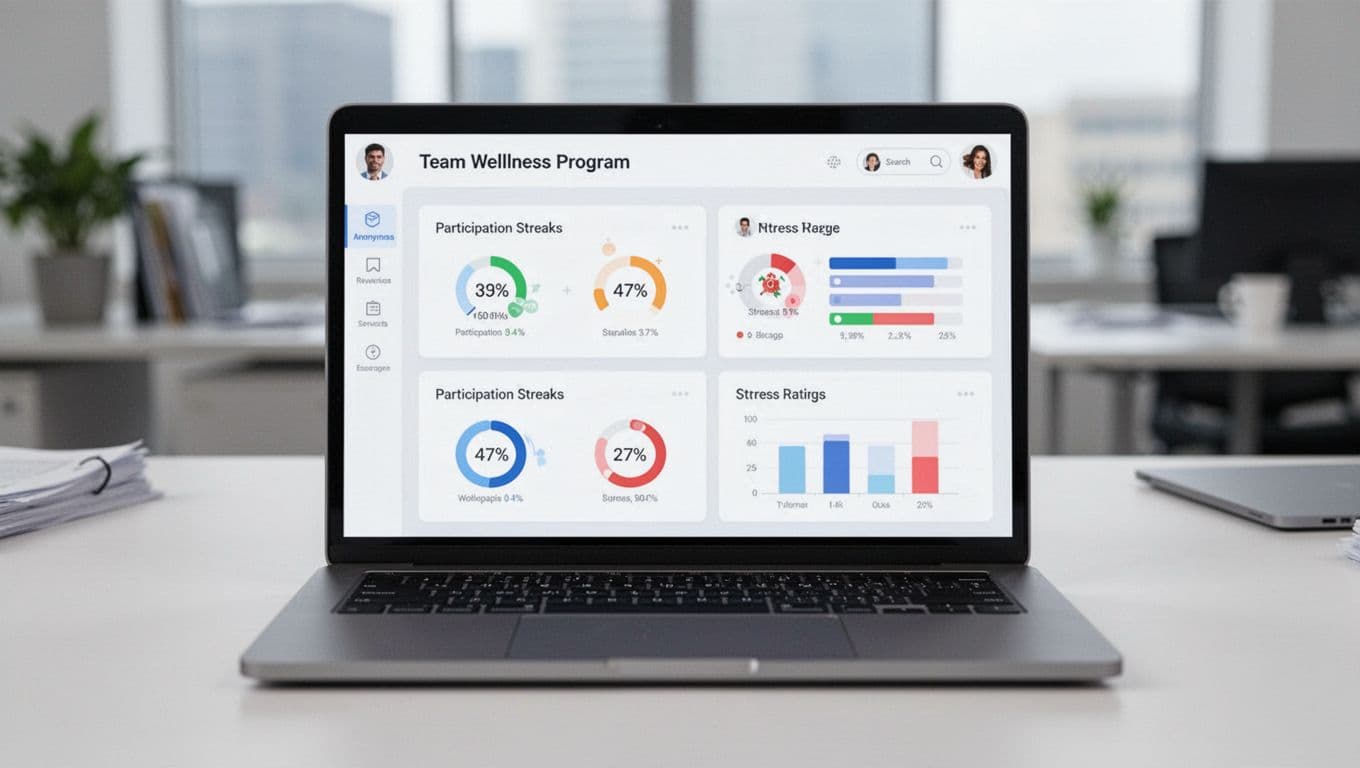 An example of aggregated, anonymized program metrics viewed at a high level (created with AI).
If you can't measure it at all, you can't manage it. If you measure it in the wrong way, people won't touch it.
The goal is to evaluate the program without creeping anyone out. That means aggregated insights, not individual surveillance. It also means clear communication: what you track, what you don't, and why.
Think in two layers:
- Leading indicators: Are people using it repeatedly?
- Outcome signals: Do people say it helps them feel less stressed or more focused?
Be cautious with hard claims. Breathwork can support better days. It can't fix unrealistic workloads, poor management, or constant emergencies. Measure the program, but also treat the metrics like a mirror.
If you want a real-time view of where breathwork sits in the wider market, providers like Frequency Breathwork show how community-based sessions are positioned, while corporate wellness trend reports show why employers keep moving toward shorter, daily resets.
The "good metrics" dashboard for a breathwork program
Use a small set of metrics that tell a story without invading privacy:
- Participation rate: Percent of invited employees who try at least one session.
- Weekly active users: Who comes back, not just who shows up once.
- Session completion rate: Drop-offs can signal sessions are too long.
- Average session length: Helps you tune the default duration.
- Streaks or repeat-days: A rough proxy for habit formation.
- Self-reported stress check-ins: Simple, optional ratings before and after.
- Focus ratings: Quick "how focused do you feel?" pulse questions.
- Program sentiment: Short, anonymous feedback on usefulness.
Set a baseline before you start. Keep it light. An optional wellbeing check-in or quiz works well because it doesn't require people to write essays about their feelings.
Privacy practices that increase adoption, not fear
People won't regulate in a system they don't trust. If the program feels like a backdoor performance tracker, adoption will die quietly.
Build trust with boring clarity:
- Voluntary participation, with no penalties and no callouts.
- Anonymized, aggregated reporting only, especially for small teams.
- No individual dashboards for managers, ever.
- Clear data retention rules, shared upfront.
- A simple escalation path: if someone needs clinical support, point them to proper resources.
Here's a short policy line leaders can copy into an internal note:
- Participation is optional.
- We don't track individual performance or health data.
- We only review aggregated engagement and anonymous feedback.
- This supports wellbeing, it's not medical care.
Say less. Mean it. Then stick to it.
Conclusion
A corporate breathwork program doesn't need fanfare. It needs reliability. Short breathing moments, repeated often, can help teams reset faster, reduce perceived stress, and return to work with steadier focus. That's the point. Not perfection, not performative calm.
If you're serious, pilot it for four weeks. Keep it optional, keep it short, and measure adoption without surveillance. Then iterate.
Pausa fits this model: guided breathing that works from day one, AI-powered mood tracking that recommends techniques, a 10-day journey for beginners, streaks for habit-building, iOS and Android support, simple pricing starting around $2 per employee per month, and anonymized reporting. To see how a B2B2C rollout works in practice, explore the Pausa Business blog on workplace wellness. Ready to test the simplest next step, download Pausa (English) and take a two-minute pause today.

