The slide deck is ready. The numbers are clean. Still, when the all-hands starts, your throat tightens like a drawstring.
Your heart thumps too hard. Your mouth goes dry. You hear your own voice and think, "Why do I sound like that?"
That's stage fright, and it shows up in boardrooms as often as it does on stages. It's not a character flaw. It's your body trying to protect you, even when you don't need protecting.
This article gives you a practical way to work with that response using breathwork, not long meditation sessions. The approach is simple on purpose. Pausa, a guided breathing app, was created after its founder experienced panic attacks and went looking for relief that actually fit real life. The surprising answer was not complicated routines, but short breathing exercises you can do anywhere, even five minutes before a pitch.
If anxiety feels constant, overwhelming, or starts to affect daily life, consider talking with a licensed mental health professional. Breathwork can help, but support matters too.
What stage fright does to your body, and why breathing works when willpower fails

An executive takes a quiet breath pause before a high-stakes meeting, created with AI.
Stage fright is your stress response showing up at the worst time. Your nervous system reads "eyes on me" as risk, then flips the switch to fight-or-flight. That can mean a faster heart rate, tight chest, shaky hands, and a voice that feels thin or rushed.
Willpower struggles here because your body is already running a safety program. Telling yourself to "calm down" is like asking a smoke alarm to be quieter while it thinks the kitchen's on fire.
Breathing helps because it's one of the few things you can control that directly affects your nervous system. A slower, steadier breath, especially a longer exhale, can send a "we're safe" signal back through the body. You're not trying to erase nerves. You're trying to lower the volume so your brain can do its job again.
This matters at work because there's rarely a perfect setup. You might be presenting five minutes after a tough email. You might be answering questions with no quiet room, no warm-up, and no time. Breathwork is built for that reality. It's portable, quick, and discreet.
If you want a deeper discussion of why "just breathe" advice often fails without a method, see this perspective on why generic breathing tips don't stick.
Common signs, from a racing heart to a voice that won't cooperate
Stage fright looks different for each person. The pattern, however, is usually consistent once you spot it.
- Physical: tight jaw, dry mouth, shallow breathing, shaky voice, sweaty palms, stomach flips
- Mental: blank mind, tunnel vision, harsh self-talk, fear of being "found out"
- Behavior: rushing, reading slides, over-prepping, avoiding speaking, apologizing too much
Quick self-check: think of your last high-stakes meeting. What happened first, body or thoughts? That first domino is your best target for practice.
The breath-stress loop, and how to break it in under 2 minutes
When you're nervous, you tend to breathe higher in the chest, faster, and sometimes you hold your breath without noticing. That pattern can make the body feel even more alarmed. Then your thoughts chase the sensation, and the loop tightens.
Breathwork breaks the loop by creating a tiny pause between sensation and story. You give your body a rhythm that says "steady," even if your mind is still loud.
When you can't think your way into calm, you can often breathe your way into enough calm to think.
In the next section, you'll get three techniques with different "time costs": about 30 seconds, 60 seconds, and 2 to 5 minutes.
Your pre-meeting breathing plan, three quick techniques for calm and a steady voice
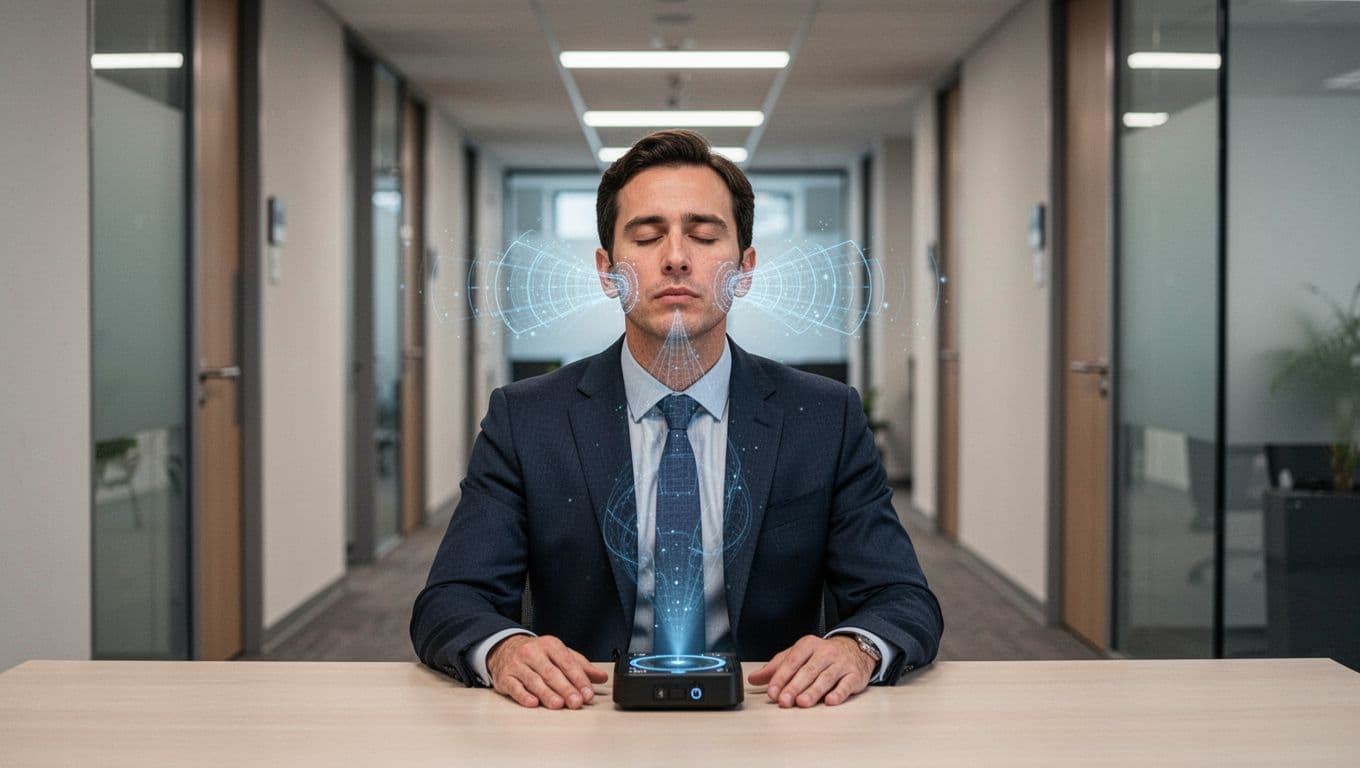
A discreet breathing reset at a desk before a meeting, created with AI.
You don't need special gear. You don't need incense. You just need a minute and a decision: "I'm going to slow this down."
A few safety notes first. Breathe gently and stop if you feel dizzy. If you have respiratory or heart conditions, or a history of fainting, check with a clinician before trying intense breathing practices. Keep these exercises comfortable, not heroic.
If you want a guided option that makes it easier to stay consistent, download Pausa for guided breathing breaks. It's designed for real-life moments, when you need something simple, fast, and supportive, without turning it into a long meditation ritual.
Box breathing for control when you feel on the spot
Box breathing is structured, which helps when your mind feels chaotic.
Try the classic 4-4-4-4 pattern:
- Inhale through your nose for 4 seconds.
- Hold for 4 seconds (soft hold, no strain).
- Exhale through your nose for 4 seconds.
- Hold for 4 seconds.
Do 3 to 5 rounds. That's usually enough to feel a shift.
If holding feels stressful, use a gentler version: 4-2-4-2.
Use it right before you unmute, right before you walk into the room, or while someone else is doing intros. While you breathe, unclench the jaw and drop the shoulders. A loose jaw often leads to a steadier voice.
Resonant breathing for a smooth voice and steady pace
Resonant breathing is slower and smoother, like setting a metronome for your nervous system. Aim for 5 to 6 breaths per minute:
- Inhale for about 5 seconds
- Exhale for about 5 seconds
Do it for 2 to 5 minutes.
This is a great warm-up while reviewing your first slide or opening line. The slower pace tends to reduce rushing because your voice rides on the exhale. When the exhale is steady, your speaking often becomes steadier too.
If you want more ideas for breath control tied directly to speaking, this list of breathing exercises for voice control can give you extra options without changing your core routine.
The physiological sigh for sudden spikes of anxiety
Sometimes panic hits like a wave. A surprise question. A tech glitch. A senior leader frowning for no clear reason.
Use the physiological sigh, a quick reset many people find calming:
- Take a deep inhale through your nose.
- At the top, take a second short "sip" of air.
- Then exhale slowly, long and easy.
Do 2 to 3 rounds. Keep your shoulders down.
This technique is especially useful when you have no time. You can do it while you're walking to the room or while someone else is speaking.
For a simple explanation of why breath shifts stage nerves so quickly, this article on breathing techniques for stage fright connects breath mechanics to the voice in plain language.
Breathing in the moment, small moves you can do while you're speaking

A calm pause during a virtual meeting, created with AI.
Pre-meeting breathing helps, but the real test is mid-sentence. That's when the room feels bright, and time feels fast.
The goal in the moment is not perfect breathing. It's micro-pauses that give your body traction. Think of them like putting your hand on a railing. You're still moving forward, but you're not slipping.
On Zoom, the pressure can feel different. You see your own face. You can't read the room well. Still, the same rule applies: slow the exhale, and you often slow the spiral.
A silent reset between sentences that makes you sound more confident
Try this quiet pattern while speaking:
- Exhale fully at the end of a sentence (don't force it, just finish it).
- Inhale low, toward the belly or lower ribs.
- Speak on the exhale.
- Pause for half a beat before the next sentence.
That pause can sound like confidence, even if it started as survival.
If you need a line that buys you one calm breath, use a simple script: "Let me think for a second."
Then take one slow inhale and one slow exhale before you answer.
If your mind goes blank, use a breath and a bridge line
Blank mind happens to smart people. It's a stress symptom, not a sign you're unprepared.
Here are a few "bridge lines" that sound natural in corporate settings. Pair each with one slow breath before continuing:
- "That's a good question. Here's how I'm thinking about it."
- "Let's separate the short-term from the long-term."
- "Before I answer, let me clarify what success looks like."
A calm bridge line gives your brain a moment to reload. Your audience rarely notices the reset.
How to stop rushing, without forcing yourself to slow down
Rushing usually comes from breath, not attitude. If your exhale is short, your words often sprint.
Use the "longer exhale" trick: make your exhale slightly longer than your inhale for two or three breaths while you talk. Don't overdo it. You're aiming for smooth, not dramatic.
Also try a pacing rule: one breath per idea. If you have three key points, you need at least three full breaths. That alone can clean up your delivery.
In person, plant your feet and soften your hands. On Zoom, lower your shoulders and look at the camera only on your main points. Let the slides do less work, and let your pauses do more.
Make stage fright smaller over time, a simple weekly breath habit that sticks

Photo by Cup of Couple
The fastest way to reduce stage fright long-term is to teach your body a new default. That doesn't require an hour a day. It requires repetition that's small enough to keep.
A useful rhythm is short daily sessions, plus low-stakes reps. For example, do two minutes of resonant breathing, then say your opening lines out loud. Your brain starts linking "speaking" with "steady breath," not only with danger.
Guided tools can help here because they remove friction. Pausa is built around brief audio-guided sessions and habit streaks, so you can practice without overthinking. It also offers a beginner-friendly journey that helps you build skill step-by-step, plus mood tracking that can help you notice what works best for you on stressful days. The point is companionship and structure, not another obligation.
If you want additional perspectives on quick breath tactics for stage nerves, this piece on breathing techniques to calm stage fright offers simple cues that pair well with a daily routine.
A 7-day plan for your next presentation, 3 minutes a day
- Day 1: Learn box breathing, 3 rounds.
- Day 2: Learn resonant breathing, 2 minutes.
- Day 3: Breathe, then speak your first 30 seconds once.
- Day 4: Breathe, then speak your close once.
- Day 5: Add mild stress (stand up, timer on), then breathe after.
- Day 6: Do a full run-through, then a physiological sigh.
- Day 7: Two minutes resonant breathing, then go. Keep it simple.
After-action calm, how to recover after a talk so your body doesn't dread the next one
Your body remembers endings. If every presentation ends with you tense, replaying mistakes, your nervous system starts to dread the next one.
After a talk, take two minutes to downshift. Try resonant breathing or a few physiological sighs. Then do a quick reflection:
What went well? What will I adjust next time?
That's it. Close the loop. Teach your body, "We spoke, we're safe, we're done."
Conclusion
Stage fright is normal, especially when the stakes feel real. Breathwork gives you a fast, practical way to steady your body when your mind wants to sprint. Use box breathing for control before you speak, resonant breathing to smooth your pace, and the physiological sigh for sudden spikes.
If you want help staying consistent, download Pausa and use guided breathing pauses in the moments that actually matter, before the meeting, during the Q&A, and after you log off. Take one slow breath before your next sentence, then another before your next decision. If anxiety feels constant or overwhelming, reach out to a mental health professional for support.

