

Your hands feel a little shaky. Your throat tightens. Your heart acts like it's trying to sprint up a hill.
That's not you being "bad at presenting." That's a normal stress response. When a presentation matters, your brain can read it like a threat. Adrenaline rises, your breathing gets shallow, and your thoughts start to race.
The good news is you can interrupt that loop. Below is a simple plan you can use in three time windows: the next 30 minutes, the next 5 minutes, and the first 60 seconds of the talk. You don't need to meditate to use any of it. You just need a few conscious breaths, plus a couple of smart choices.
Calm your nerves fast with a 3-minute breathing reset
 An easy breathing reset you can do in a hallway before you speak, created with AI.
Stage fright often starts in the body. Your lungs speed up, your chest tightens, and your voice feels thin. So instead of arguing with your mind, start by changing the signal your body is sending.
Here's the 3-minute reset you can do in a hallway, restroom, car, or during a Zoom break.
First, drop your shoulders on purpose. Let your jaw unclench. Put both feet flat on the floor.
Next, breathe in through your nose gently, then make the exhale longer than the inhale. A longer exhale tends to cue the body to shift into a calmer gear, because it nudges your nervous system toward "safe enough" instead of "danger now."
Keep the breaths soft. You're not trying to win a breath-holding contest. If you feel dizzy, stop and return to normal breathing.
One more thing: don't wait until you're panicking. Do this when you feel the first signs, like the tight chest, the fast thoughts, or that weird "I suddenly forgot English" feeling. For a clear, work-focused take on managing anxiety before you speak, see HBR's advice on preventing anxiety from hijacking presentations.
If you want more guided options later, you can also browse Pausa's library of breathing exercises for stage fright and other stress moments.
Do the 4-7-8 (or 4-4-8) breath to slow the spiral
Use this when your nerves start climbing fast.
- Inhale through your nose for 4.
- Hold gently for 7.
- Exhale slowly for 8, like fogging a mirror.
That's one round. Do 3 to 5 rounds.
If the long hold feels like too much, use the simpler version:
- Inhale 4
- Hold 4
- Exhale 8
The main lever is still the same: a slow exhale. Keep your tongue resting softly behind your top teeth, and let your shoulders stay heavy.
If you only do one thing before you present, extend your exhale. It's the fastest way to unhook the body from the stress spike.
A quick "silent practice" you can do while others talk
Sometimes you can't close your eyes. Sometimes you're being introduced. Sometimes you're on camera and everyone's watching your little Zoom square.
Try this discreet pattern:
Inhale through your nose for 3 to 4 counts, then exhale through your nose for 5 to 7 counts. Repeat. No one will notice.
Now add a physical anchor so your brain has something steady to hold.
Feel your feet in your shoes. Press your toes down lightly. Let your jaw loosen, like you're about to yawn but don't.
This works because your body stops acting like it's floating. You become a person standing on a floor, breathing on purpose, about to say something useful.
Trade panic thoughts for a presenter mindset that actually helps
 Calm energy looks like this: open posture, steady pace, and warm focus, created with AI.
Once your breathing slows, you can work with your thoughts without wrestling them. Stage fright usually lies in predictable ways. It says, "They'll notice I'm nervous," or "If I mess up one line, it's over."
A better goal isn't "feel confident." A better goal is "be useful, even while nervous."
Recent coaching guides and research-based manuals in 2025 and 2026 keep circling the same idea: treat nerves as information, then shift attention to what you're doing and who you're helping. That's also the spirit behind Matt Abrahams' practical list in Stanford's handout, Top 10 tips for managing presentation anxiety.
Reframe "I'm anxious" as "I'm ready" so your energy works for you
Anxiety and excitement share the same body signals. Fast heart, warm face, extra energy. Your brain labels it as danger, but you can relabel it as readiness.
Use one of these lines. Keep it short:
- "I'm ready."
- "My body is powering up."
- "This energy helps me speak."
Say it out loud once, even under your breath. Then move to action. Don't spend ten minutes negotiating with your mind. Take the next step: open your notes, step forward, greet the room.
Stop performing, start helping, focus on one person at a time
Stage fright gets worse when you try to "look impressive." That goal makes every tiny mistake feel expensive.
Instead, switch your job description. You're not there to be judged. You're there to help someone understand, decide, or do something.
Use a simple eye-contact plan. Pick three friendly faces in the room, then rotate between them. If you're on Zoom, pick three camera dots (or three names on the grid) and rotate.
This makes the room feel smaller. It also steadies your pace, because you're speaking to humans, not to a blurry crowd.
A good presentation isn't perfect. It's clear. Aim for clear, and your nervous system calms down faster.
Prep in a way that builds real confidence (without over-rehearsing)
 Practicing out loud builds "real" confidence, not just familiarity, created with AI.
There's a kind of prep that feeds stage fright. It looks like rereading slides at midnight and whispering lines in your head. It feels busy, yet it doesn't build trust in your voice.
Then there's prep that settles your nerves because it proves, "I can do this."
Speak out loud. Trim your message. Learn your opening. That's the combo.
If you're presenting at work, it also helps to keep day-of choices boring. Sleep matters more than a new slide transition. A heavy lunch can make your body feel sluggish. Too much caffeine can push your heart rate into "uh-oh" mode.
If you want a workplace-friendly set of tips for public speaking anxiety, The Muse's guide to overcoming public speaking anxiety is a helpful read, especially for professionals who present often but still get the jitters.
Memorize the first 30 seconds so you can start on autopilot
Nerves peak early. The first minute is where your voice might shake, your hands might feel strange, and your mind might go blank.
A memorized opener buys you time. It lets your body settle while your mouth keeps moving.
Pick one opening style and lock it in:
A simple promise: "In the next 10 minutes, you'll know exactly how we're solving X."
A quick story: "Last Friday, we hit a problem that looked small, but it wasn't."
A surprising stat (only if you trust it): "Here's the number that changed how we see this."
A clear agenda: "First I'll cover X, then Y, then we'll decide Z."
Don't memorize the whole talk word-for-word. That can make you brittle. Instead, memorize the opening and your key points, then speak like a human between them.
Rehearse out loud, then practice with "safe pressure"
Confidence grows in steps. You don't need a perfect rehearsal schedule. You need a small ladder you can climb.
Start alone and say it out loud once. Next, record a run-through on your phone. Watch it one time, not five, and only look for one fix (usually pacing). Then run it for a friend or teammate, even if it's messy.
If you can, practice in the room. A quick walk-through in the space reduces surprise. Your body relaxes when the environment feels familiar.
For slides, keep cue words short. One line is enough. Full paragraphs tempt you to read, and reading increases panic because your eyes get stuck.
Your last 5 minutes before you speak, a simple routine that works anywhere
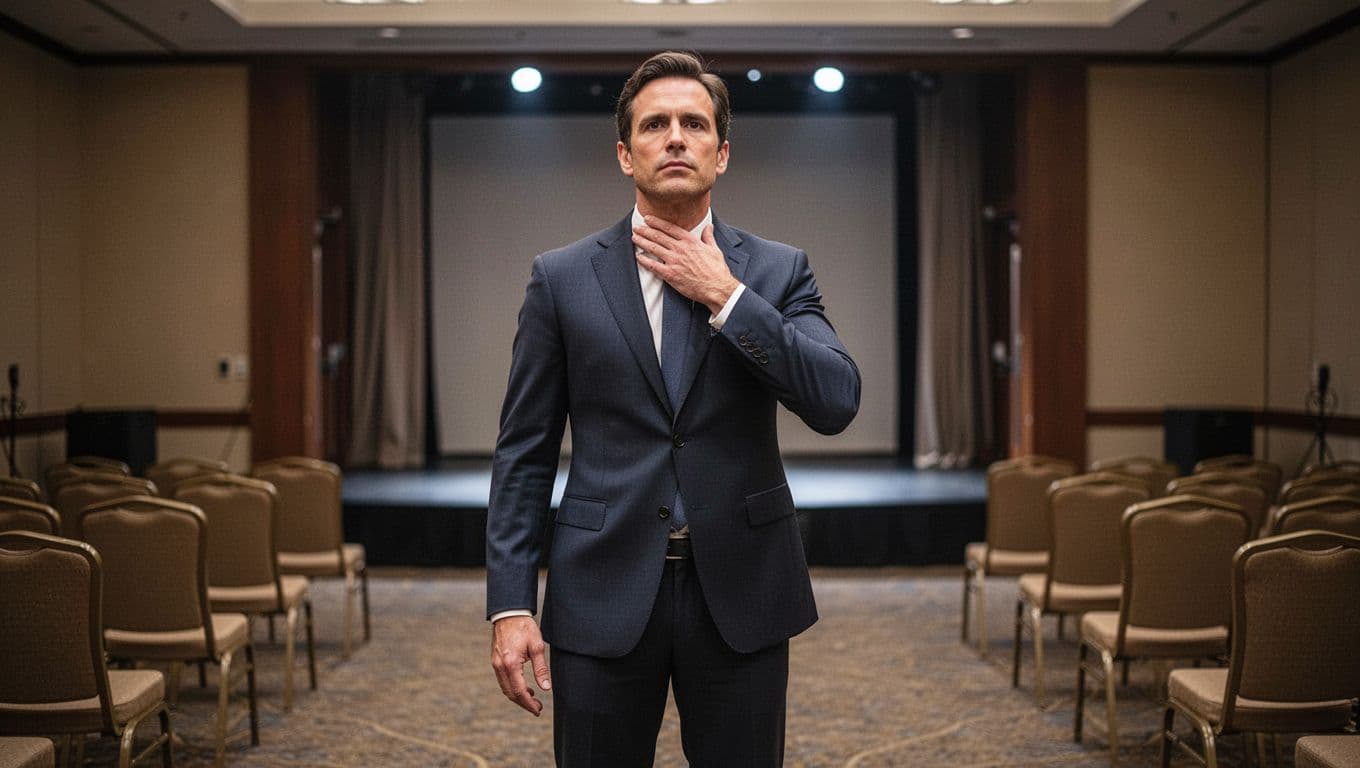 A simple pre-talk routine can steady your voice and posture in minutes, created with AI.
When stage fright hits, you don't need fifteen new ideas. You need a routine you can repeat until it feels like muscle memory.
Think of it like tying your shoes. Same steps. Same order. Less thinking.
Here's a timing-based routine that fits right before you present.
At T-minus 5 minutes: stop multitasking. Stand up if you can. Roll your shoulders slowly. Unclench your hands.
At T-minus 2 minutes: take three slow breaths with longer exhales. Sip water. Check your first line.
At T-minus 30 seconds: plant your feet. Look at one person. Start 10 percent slower than feels normal.
This is also where you give yourself a small permission slip: you're allowed to pause. You're allowed to take a breath mid-sentence. Silence isn't failure. Silence is punctuation.
For more nuanced public speaking tips beyond "just breathe," this article on what actually works for stage fright before presentations adds practical perspective, especially on what to do when your mind still feels loud.
A quick routine: loosen, breathe, then choose one clear goal
Try this mini script in your head:
Loosen: "Jaw soft, shoulders down."
Breathe: three slow exhales.
Goal: "Help them understand X."
Keep the goal small. "Be amazing" is vague. "Speak clearly" is real. "Explain the next step" is real.
Then, as you begin, aim your voice toward the back of the room (or the farthest camera). It often makes you sound steadier without pushing.
Use guided breathing when you need a steady voice and a calm chest
Sometimes you're not just nervous. You're close to panic. In that moment, a short guided session can keep you from spiraling, especially if long meditations aren't your thing.
That's the idea behind Pausa. It was created after real panic moments, then shaped into something simpler: science-backed breathing patterns you can do in minutes, without needing to "be good at meditation." It's designed for real life, including the messy five minutes before a talk.
If you want an optional tool you can pull up right before presenting (or right after to come down), use a 3 to 5 minute guided session in Pausa's English download page.
Conclusion
Stage fright before a presentation doesn't mean you're broken. It means your body cares, and it's trying to protect you.
Calm the body with longer exhales, aim your mind at helping people, and prep your opening so you can start strong. Then test one technique in your next small meeting, not just the big talk. If anxiety feels intense or constant, professional support can help, and self-tools are not a diagnosis.