

Most HR and people leaders don't struggle to explain why wellbeing matters. They struggle to get senior leaders to fund it, back it, and talk about it without sounding forced.
That's the real job in 2026. Wellbeing is no longer a perk pitch. It's a business case. Stress is still high, burnout is still common, and leaders are watching retention, output, and manager strain more closely than they did a few years ago. They should be. Depending on the survey, 44% to 83% of US workers report some level of burnout.
So stop selling care as sentiment. Start framing it as performance, risk, and operating discipline.
Start with the business case executives already care about
If your pitch starts with activities, you've already lost. Executives don't fund yoga, apps, or awareness weeks on faith. They fund outcomes.
That means your first slide, first sentence, and first ask should connect wellbeing to metrics leaders already track: retention, sick days, productivity, safety, claims, and manager load. Not soft language. Not moral pressure. Business friction.
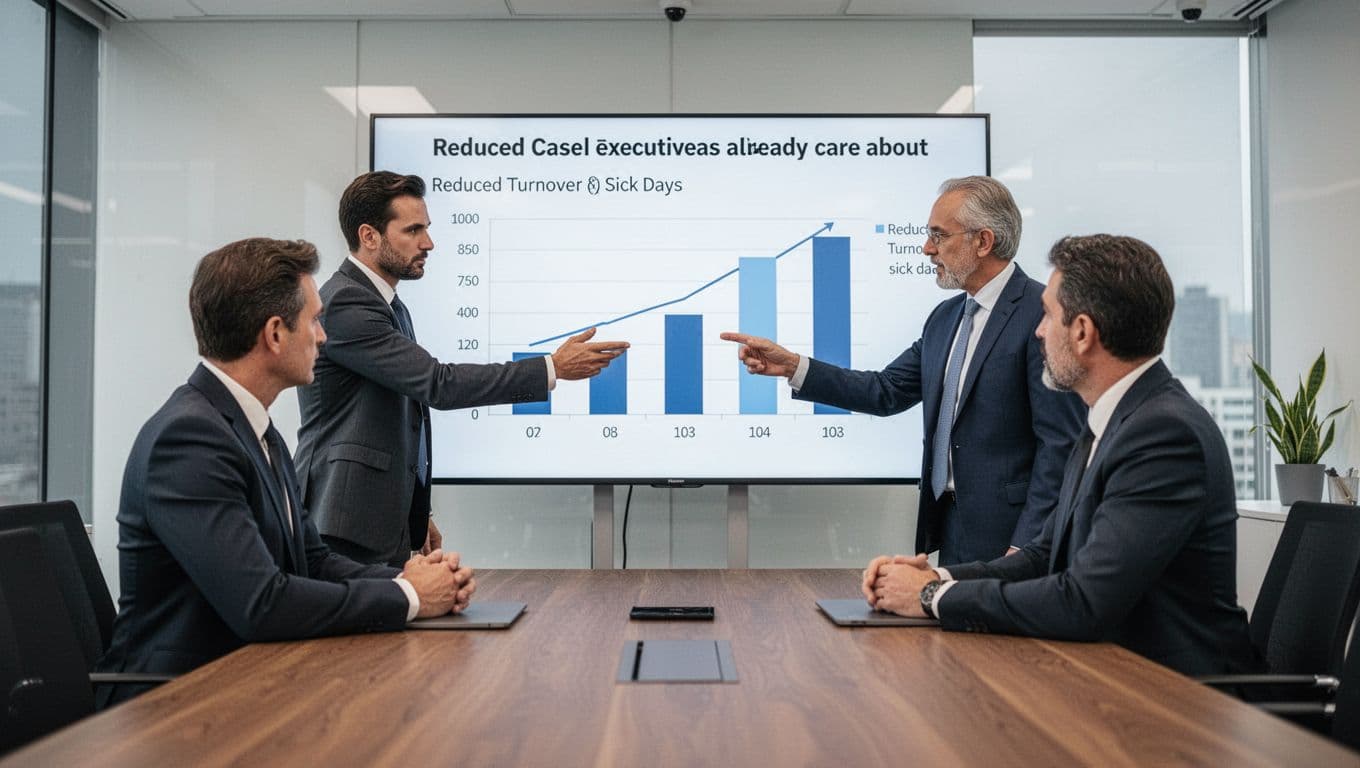
Connect wellbeing to turnover, absence, and performance
The cleanest path to getting exec buy-in for wellbeing is simple: show where stress shows up on the balance sheet.
In 2026, burnout isn't rare. It's normal enough to damage operations. Real-time US data shows burned-out workers are nearly three times more likely to job hunt, 45% versus 16%. They're also 63% more likely to take sick days. High-burnout teams can see productivity fall by 18% to 20%.
That's the translation executives need.
If you can say, "Our customer support team has rising absence, lower engagement, and weak retention, and stress is part of that pattern," the topic changes. It stops sounding like a benefit request. It starts sounding like a fix for waste.
Recent reporting on the ROI of employee engagement in 2026 makes the same point: leaders respond when the case is tied to churn, absence, and output. That's not cynical. It's how budgets work.
There's also a blunt truth here. Many employers already offer support, but only 53% of employees know how to access mental health benefits. So even before you ask for more money, you may have a visibility problem. Fixing that alone can lift results.
Frame the cost of doing nothing
The soft case gets polite nods. The risk case gets meetings.
Poor wellbeing creates hidden cost in layers. First comes missed work. Then lower focus. Then managers spend time holding together teams that are tired, reactive, and short-tempered. Finally, people leave, and the company pays twice, once for the loss and again for the replacement.
A 2026 HR Dive report says turnover costs exceed $45K per worker. That number gets attention because it reframes the whole choice. The question is no longer, "Can we afford wellbeing?" It's "How much are we already paying for the lack of it?"
Inaction is not neutral. It's a business decision with a human bill attached.
Name the cost of delay. Name the teams carrying the strain. Then make the contrast clear: small investment now, or larger losses later.
Build a pitch that speaks the language of the C-suite
A good wellbeing pitch sounds less like HR and more like finance with a human face. Clear claim. Clear cost. Clear path.
Keep it short. Most executive resistance isn't hostile. It's overloaded. They don't need a manifesto. They need a case they can repeat to each other.

Lead with outcomes, not activities
Don't pitch a meditation app. Don't pitch a webinar series. Don't pitch a month-long challenge as if the format matters on its own.
Pitch the business problem, then the result you expect.
This quick translation helps:
| Weak framing | What execs hear | Better framing |
|---|---|---|
| Employees want more support | Soft request | Stress is driving exits and absences in sales |
| We want a wellness platform | New spend | We want a low-risk pilot to cut sick days |
| Participation was high | Activity | Retention improved and managers reported less strain |
That shift matters because executives buy reduction in friction. They buy fewer exits. They buy steadier teams. The program itself is only the delivery system.
I've seen pitches fail because they sounded like a menu. Too many features. Too much enthusiasm. Not enough operating logic. Strip it down. Tie wellbeing to one company goal, maybe retention in frontline roles or burnout in managers. Then keep repeating that line.
Use a simple ROI story with a few strong numbers
Don't bury leaders in research. Use three numbers, maybe four. Any more and you look uncertain.
A solid ROI story can sound like this: burnout is high, stressed workers take more sick days, high-burnout teams lose output, and turnover is expensive. Then connect those facts to your own numbers, absenteeism, claims, engagement scores, exit comments, or manager feedback.
If you need outside support, a practical guide on corporate wellness ROI data can help shape the math. But your internal data will always land harder. A rough estimate from your own workforce beats a polished stat from somewhere else.
Keep the logic simple:
- Problem: stress is hitting attendance, retention, or focus
- Intervention: a defined support plan for a defined group
- Expected return: fewer sick days, lower exits, better manager capacity
That's enough for a first yes. More detail can come later.
Make it easier for leaders to say yes
Executives don't reject wellbeing only because they doubt the need. They reject it because the ask feels vague, expensive, or hard to govern.
So lower the temperature. Lower the risk. Make the decision easy.

Start small with a pilot instead of asking for a full rollout
A pilot is often the smartest move because it turns opinion into evidence.
Pick one group with a clear pain point. Maybe a high-turnover team. Maybe managers in a burned-out function. Run the pilot for 8 to 12 weeks. Set a few success metrics before day one, such as sick days, retention, engagement pulse scores, or manager feedback. Then report results in plain language.
This is why starting small with wellness works so well. It reduces financial risk and political risk at the same time. Leaders don't have to believe your whole theory. They only need to approve a test.
A good pilot has boundaries. Clear group. Clear budget. Clear owner. Clear finish line. Without that, it becomes theater.
Bring key leaders in early, before the final ask
Don't save the full pitch for the executive meeting. That's late. The real work happens before the room.
Talk to finance first, because budget objections always arrive early or late. Talk to operations, because they know where strain shows up in output. Talk to HR partners and influential managers, because they'll tell you where the story is weak. Also, they'll tell you where it's already obvious.
Early input does two things. It surfaces resistance while you can still adjust. It also creates allies who feel some ownership of the plan.
A useful guide to leadership buy-in for workplace wellness makes the same case. People support what they helped shape. That rule holds in every boardroom.
Keep those conversations short. Ask what would make the proposal easier to approve. Ask what metric matters most to them. Then tune the pitch to those answers.
Ask visible leaders to model the behavior
Approval is not sponsorship. Budget is not culture.
If executives want adoption, they have to show up in small, visible ways. That might mean joining a manager session, talking openly about healthy work norms, or backing focus time and PTO use with their own behavior. Not speeches. Signals.
When leaders model the habits, people trust the program more. When leaders only sign the budget, staff often read the whole thing as branding.
This part matters because employees watch what gets rewarded. If the message says "protect your energy" but the senior team praises midnight emails, the real policy is obvious. Culture follows proof, not posters.
Prove impact after the yes so support keeps growing
Getting exec buy-in for wellbeing is not a one-time win. It's a maintenance job.
Once leaders say yes, your next task is to show movement without drowning them in dashboards.
Track a few metrics that matter most to the business
Pick a short list. Participation can stay on the list, but it can't lead the story.
Better measures include sick days, retention, engagement, benefit use, and manager feedback. If the pilot targeted one pain point, tie your reporting to that pain point. Keep the view simple enough that a busy leader can grasp it in 30 seconds.
More data doesn't always mean more trust. Often it means more fog.
Share quick wins and employee stories alongside the data
Numbers matter because they prove change. Stories matter because they make the change stick in memory.
So pair one or two metrics with one grounded example. Maybe a manager reports fewer callouts. Maybe a team lead says focus improved after protected break blocks and better benefit access. Keep it factual. Keep it short. No sentimental language. No glossy case study voice.
That's how support grows. Not from hype. From evidence people can repeat.
Leaders support wellbeing when it stops looking like a side project and starts acting like part of how the business runs. That's the whole play.
Tie the case to one hard business problem. Put a low-risk pilot behind it. Measure a few outcomes that matter. Then report back with proof, not polish.
Start there. Pick one team, one pain point, and one executive who will say the quiet part out loud: stress costs money, and pretending otherwise costs more.