

Late-night work culture looks like commitment, until it starts acting like a tax. Sleep drops, attention narrows, and small mistakes multiply. Then friction shows up in meetings, reviews, and customer work.
This isn't a personal problem. It's an operating system issue.
In the US, a large share of workers report sleep loss, and many get under 7 hours a night. That matters because tired brains miss details, react faster, and think slower. Some workers even call in sick after a bad night, not because they're lazy, but because their body taps out.
Below is a practical way to push late-night work back where it belongs: out of the default. Simple sleep challenges work because they target behavior (wind-down routines, stress relief, screen boundaries), not perfect sleep stats. They also work across remote, hybrid, and shift teams.
Start with a sleep challenge that people will actually join
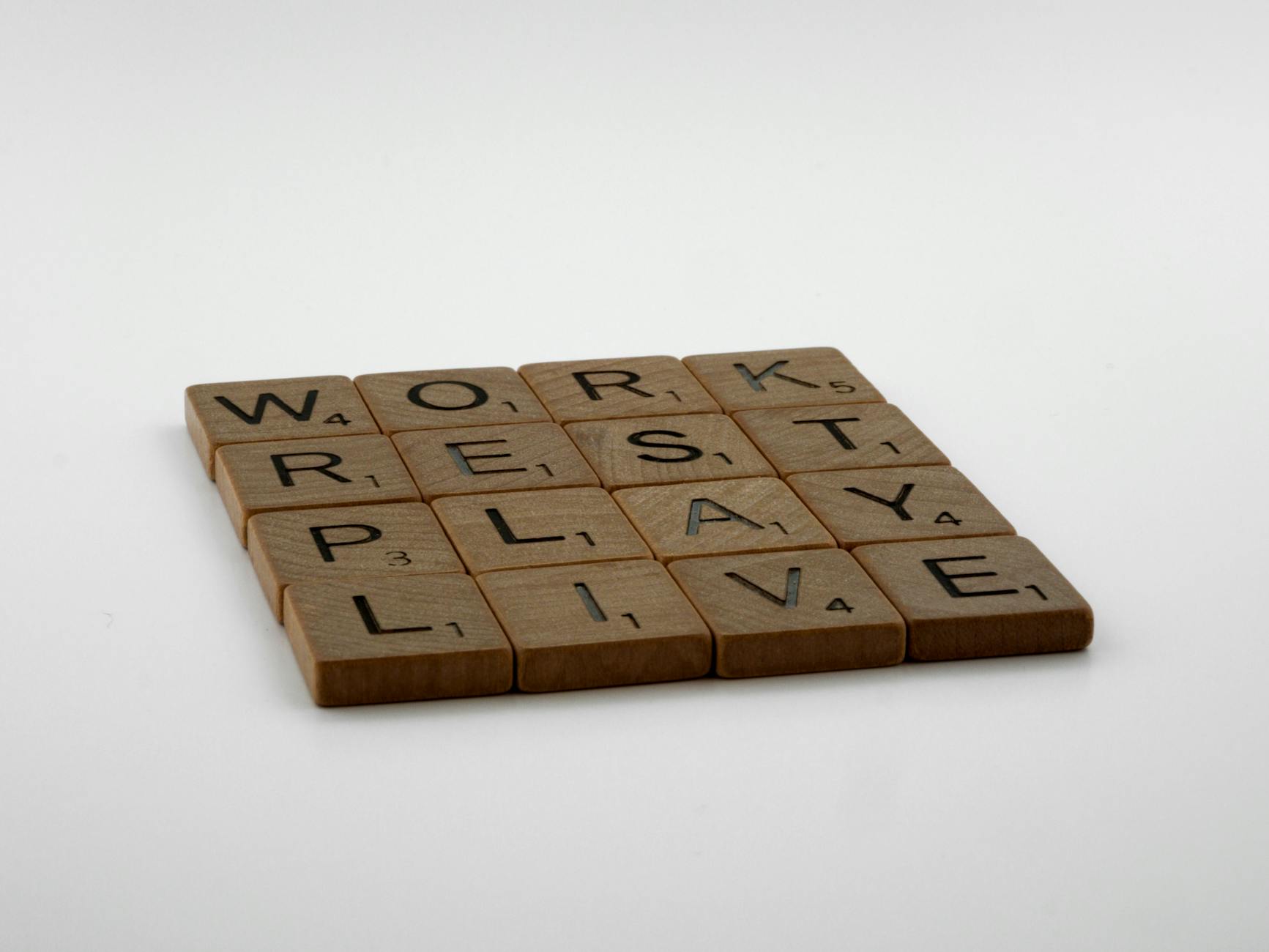 Photo by Brett Jordan
If you want to reduce late-night work culture, don't begin with a policy. Begin with a short, low-drama experiment.
Sleep challenges fail when they feel like surveillance. They fail when they reward only "perfect sleepers." They fail when the tracking is awkward. The fix is boring, and that's good.
Keep it short. 7 to 14 days works. Long enough to feel change, short enough to try without resentment.
Make rules simple:
- One clear daily action.
- A private way to log it.
- Rewards that don't punish parents, caregivers, or shift workers.
Also, make privacy non-negotiable. No public leaderboards tied to hours slept. No "prove it" screenshots. No medical questions. Sleep is personal, and teams know when you cross the line.
What you can track, with low friction:
- Consistency (did you start your wind-down within the same 60-minute window?).
- A single habit (screen-free 60 minutes, caffeine cutoff, or a 3-minute shutdown ritual).
- Self-rating (energy or focus, 1 to 5, anonymous).
What not to track:
- Medication details.
- Diagnoses.
- Anything that creates shame.
Late-night work culture grows in the cracks: after-dinner Slack, "quick" emails at 10 pm, and the feeling that stopping means falling behind. Messaging norms matter here. For a useful set of guidelines, see meeting and messaging practices that protect sleep.
If your challenge needs trust to work, protect trust first. Everything else is theater.
A final point CEOs appreciate: adoption. Most wellness tools get ignored because they demand too much time. A challenge that takes under two minutes a day gets used. That's the whole game. If you want a practical blueprint for small teams, this guide on implementing wellness programs for small teams is a solid reference.
Pick the right goal, sleep hours, sleep quality, or bedtime habits
Leaders tend to choose the easiest metric. That's usually "hours slept." It's simple, and it's also fragile.
Here's a clean decision guide:
- Hours: easiest to understand, easiest to game, hardest for shift workers.
- Quality: useful if people already use wearables, but it can exclude those who don't.
- Habits: most inclusive, lowest risk, highest participation.
Start with habits. Build momentum. Then offer optional "quality" scoring for teams that want it. In other words, run one challenge with a wide door, then add an extra lane later.
Make it safe and inclusive for parents, caregivers, and shift workers
If your sleep challenge assumes everyone has a quiet home, a stable schedule, and uninterrupted nights, you'll lose the people who need support most.
Adjustments that work:
- Flexible check-ins: log the habit any time before noon the next day.
- Separate tracks for night shift: "pre-sleep routine" instead of "bedtime."
- Best improvement awards: reward progress, not perfection.
For shift workers, consider a basic "sleep kit" (eye mask, earplugs). It's cheap, and it signals respect. Quiet-time support helps too, especially if people live with roommates or kids.
If you want proof that late-night work patterns are not random, read Hubstaff's analysis of evening work as a red flag. The pattern often ramps slowly, then becomes normal. That's the exact loop you're trying to break.
10 workplace wellbeing sleep challenge ideas you can run next month
 Teams practicing a clear end-of-day stop, created with AI.
Each idea below is built for low effort and high inclusion. Notice the theme: behavior over biometrics. In 2026, that matters even more because people are burned out on tracking everything.
Challenges focused on evenings (wind-down, screens, caffeine, and worry)
- The 60-minute screen-free rule: one hour without phone scrolling before sleep.
- Pick a consistent "screens off" time window (not a fixed clock time).
- Offer substitutes: paper book, shower, light stretch, quiet music.
- Ask managers to model it by scheduling messages for the morning.
- Score privately: "Yes/No, did I do it?"
Reward: a small raffle entry per completed day.
- Caffeine cutoff challenge: stop caffeine after a set hour to reduce sleep drag.
- Choose one cutoff (for example, 2 pm) or let people pick theirs once.
- Encourage decaf swaps or herbal tea for ritual without the stimulant.
- Share one tip per day in Slack, short and non-preachy.
- Score privately: "Met cutoff, yes/no."
Reward: coffee shop gift card, plus decaf options stocked at work.
- "Worry list, close the notebook": move mental tabs onto paper.
- Two minutes: write worries, then write one next action for tomorrow.
- Close the notebook. Physically. That's the cue.
- Teach one rule: no problem-solving in bed.
- Score privately: "Did I do the two-minute close?"
Reward: notebooks or pens people actually like.
- Consistent lights-out window: reduce bedtime drift that fuels late-night work.
- Set a personal lights-out range (same 60 minutes each night).
- Keep it flexible for caregiving and shift needs.
- Encourage a "soft landing," dim lights 30 minutes before.
- Score privately: "Did I stay inside my window?"
Reward: "best consistency" prize, not "earliest bedtime."
- Bedroom setup mini-challenge: small changes that make sleep easier.
- Pick one upgrade: cooler room, darker room, or quieter room.
- Share low-cost options: fan, blackout mask, earplugs.
- For remote teams, let people expense a small item up to a cap.
- Score privately: photo not required, just self-attestation.
Reward: reimbursements or a "sleep kit" bundle.
Optional support tool: some teams add a short guided breathing routine at night, because stress is often the real fuel behind late-night work. If you want that in one tap, use Pausa as an optional companion for the challenge.
Challenges focused on the workday (stress offloading so nights get easier)
- Two-minute reset after meetings: stop carrying tension into the evening.
- Add a default two-minute buffer between meetings when possible.
- Use it for water, a short walk, or slow breathing.
- Make it normal to be "unavailable" for those two minutes.
- Score privately: "Did I take one reset today?"
Reward: team lunch budget tied to participation rate.
- No email after a set hour team pact: make night work less automatic.
- Choose one "quiet hour" (for example, after 7 pm local time).
- Use scheduled send for messages that can wait.
- Make exceptions explicit (incident response, on-call).
- Score without policing: weekly anonymous check-in, "How often did pings hit after-hours?"
Reward: extra half-day off if the team hits the goal.
- 20-minute nap or quiet break option: fatigue is not a moral failing.
- Offer a 20-minute cap, same time window each day.
- For remote staff, define "quiet break" as off-camera, off-chat.
- For on-site, designate a room or quiet zone.
- Score privately: "Did I take a quiet break?"
Reward: small wellness stipend, or a rotating "protected break" token.
- Sunlight walk at lunch: anchor circadian rhythm, reduce evening restlessness.
- Encourage 10 minutes outside, even if it's cloudy.
- Let people pair up across functions to build social glue.
- Keep it accessible, no step-count pressure.
- Score privately: "Went outside, yes/no."
Reward: walking meeting passes, or a team donation to a cause.
- Meeting hygiene week: fewer late nights start with fewer messy meetings.
- Cap meetings at 25 or 50 minutes by default.
- Require an agenda for meetings over 30 minutes.
- End with owners and next steps to prevent rework later at night.
- Score non-invasively: calendar audit at the team level, not per person.
Reward: "meeting-free" half-day or focus block.
One more angle worth knowing: bedtime procrastination. When people feel they had no control all day, they "steal" time at night, often with screens. That pattern is linked to insomnia risk in research, including this Scientific Reports paper on bedtime procrastination and insomnia. Fix the day, and nights get easier.
Make the challenge stick, measure impact, and support better sleep with breathwork
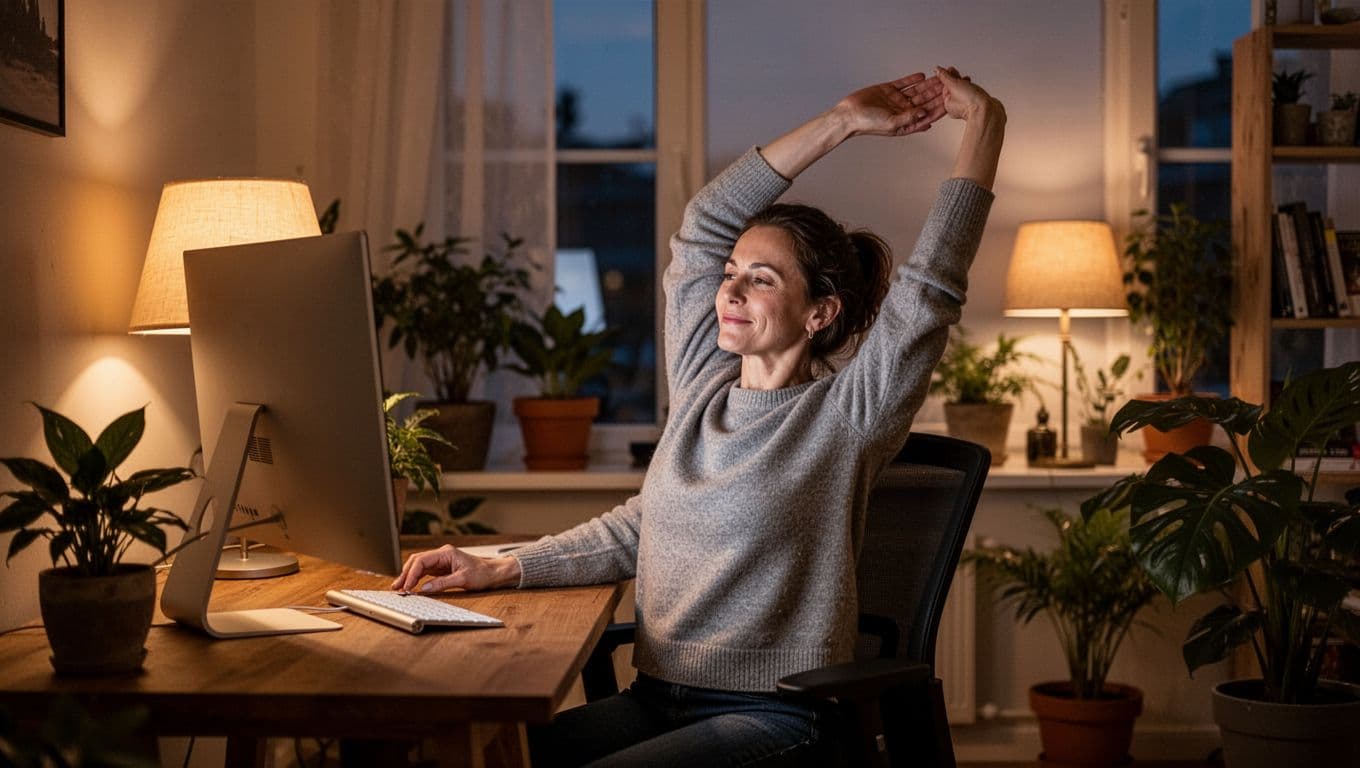 Ending the workday with a clear shut-down cue, created with AI.
A sleep challenge should not feel like "one more program." Treat it like a pilot that protects performance.
Here's a rollout leaders can copy:
Week 0 (prep, 30 minutes total)
- Pick one habit goal and one measurement method.
- Write a one-paragraph announcement (more on that below).
- Decide the reward and how winners are selected.
Week 1 (run the challenge)
- Keep comms light: one prompt every two days.
- Ask managers to model the boundary (scheduled send, no late pings).
- Make logging private and fast.
Week 2 (close and learn)
- Share results at the team level only.
- Call out what reduced late-night work, not who failed.
Comms template idea (tone matters): "We're testing a small change to reduce after-hours work and improve focus. No tracking of personal sleep data. Just one daily habit. Opt in, keep it simple."
This connects to bigger wellbeing pressure too. TELUS Health has a useful view of challenges shaping workplace wellbeing, and the theme is consistent: people carry more load, and the system has to adapt.
Now add breathwork, because stress is often what keeps people working late. If you want a simple, repeatable option, Pausa Business provides guided breathing sessions that are short and effective from day one. People don't need to meditate. They just breathe for a few minutes, then continue.
What makes it workable in companies:
- Mood-based recommendations (stress, focus, energy, calm).
- Short sessions built for real schedules.
- Screen-time lock moments that interrupt doom scrolling.
- Streaks that make habits social, without pressure.
- Fully anonymized reporting for leaders.
- Simple pricing starting around $2 per employee per month (or about $18 per year, depending on plan).
Admins can manage licenses and view engagement reports in the admin panel, without turning it into surveillance. If you want a grounded explanation of how small resets fit busy days, this piece on desk-friendly ways to ease stress matches the same logic.
What to measure besides sleep hours (so leaders can see ROI)
Sleep hours are a lagging signal. Late-night work is a behavior problem. Track what you can influence.
Practical metrics that stay privacy-first:
- Participation rate (team level).
- Self-rated energy and focus (anonymous, 1 to 5).
- Errors, rework, or QA fixes (trend, not blame).
- Sick days trend (team aggregate).
- Meeting quality (one-question pulse).
- Anonymous stress check-ins.
Poor sleep is tied to major productivity losses per worker per year in US estimates. So even small improvements can matter at scale.
For employers building a broader program, this overview of sleep programs for employers shows how organizations frame sleep as a business input, not a personal hobby.
How guided breathing fits into a sleep challenge without feeling like another task
Breathing works because it's biology, not belief.
The trick is dosage. Keep it 1 to 5 minutes. Make it optional. Make it easy to start. That's how you get real adoption.
Use the "small pauses" model:
- One short session after work to mark the boundary.
- One short session before bed to downshift.
- Optional daytime resets after tense meetings, so stress doesn't pile up.
This also helps with phone habits. Many people say they'll stop scrolling, then don't. A guided pause gives the brain something else to do, right when it wants to numb out.
Late-night work culture thrives on momentum. Small pauses break momentum on purpose.
You don't need a new personality. You need a cleaner off-ramp.
Conclusion
Reducing late-night work culture doesn't require a grand rewrite. It requires a few clear constraints that people can live with. Keep challenges easy, inclusive, and private. Focus on habits, not perfect sleep numbers. Most importantly, reduce stress during the day so bedtime doesn't become the only quiet moment people can claim.
Pilot a 7-day sleep challenge next week. Pick one habit, one reward, and one simple measure. Then watch what happens to focus, rework, and after-hours pings. If it works, scale it with Pausa Business so your team has low-friction breathing support that fits real life, not wellness theater.