

Burnout rarely starts with one hard week. It builds when pressure meets silence. People feel the load, hide the strain, and keep performing until the system breaks.
That is why psychological safety matters. When people can speak up, ask for help, and admit mistakes without getting shamed, stress stays stress. It is less likely to turn into chronic burnout. Recent research points the same way. Teams with stronger psychological safety report lower burnout, even in high-stress settings like health care.
So the practical question is not abstract. It is this: how do leaders and teams build a workplace where pressure does not become damage? The answer is not soft. It is operational. Remove fear from the workflow, and people can actually do the work.
What psychological safety really means at work
Psychological safety is simple to say and easy to fake. It does not mean constant agreement. It does not mean low standards. It does not mean nobody gets challenged.
It means people can raise concerns, offer ideas, ask basic questions, and admit errors without fear of ridicule or punishment. In other words, the team treats honesty as useful data, not as a threat. McKinsey's explanation of psychological safety gets to the core of it: the absence of interpersonal fear.
That matters because fear changes behavior fast. Once people start protecting themselves, they stop learning out loud. They edit what they say. They wait too long. Then small issues become expensive ones.
The signs your team has it, and the signs it does not
You can usually spot a safe team in five minutes. People ask follow-up questions. Someone says, "I don't know." Another says, "I think we missed something." Problems surface early, while they are still cheap to fix.

By contrast, unsafe teams have a familiar look. Meetings feel polished but empty. People nod in public and complain in private. Mistakes stay hidden until deadlines slip or customers notice. These workplace signs of psychological safety line up with what most employees already know in their gut.
Watch the timing. Healthy teams speak up early. Unsafe teams speak up late, or not at all. That delay is not a personality issue. It is a culture signal.
How a lack of psychological safety pushes people toward burnout
Burnout is often framed as a workload problem. Sometimes it is. But that is only half the story.
People can handle hard work better than they can handle hard work plus fear. When a person spends all day scanning for blame, hiding uncertainty, and masking stress, the job gets heavier than the task list suggests. The mind stays on defense, and defense burns fuel.
Fear, silence, and second-guessing create extra stress
An unsafe team forces people into constant self-protection. They rehearse every sentence before speaking. They avoid disagreeing with the loudest person. They keep quiet when they need help, because asking might make them look weak.
That creates a second job: risk management of the social kind. I've seen teams spend more energy managing impressions than solving problems. It looks professional from the outside. Inside, it is draining.
Burnout grows when heavy demands meet low safety.
The result is predictable. Focus drops. Recovery gets harder. Work follows people home because the nervous system never really stands down.
Why high-stress jobs need psychological safety even more
Some leaders treat psychological safety like a nice extra for calm environments. That gets it backward. High-stress settings need it more, not less.
A 2025 Harvard report on 27,000 U.S. health care workers found that employees in safer workplaces had lower burnout before and during crisis conditions, and they were more likely to stay in their jobs over time. The effect was especially strong for doctors, women, and people of color. You can review the findings in Harvard's coverage of psychological safety during crisis.
The lesson is blunt. Pressure does not cancel the need for safety. Pressure magnifies it. In a hospital, a factory, or a fast-moving service team, people need room to say, "Something's wrong," before the cost rises.
What leaders can do to build psychological safety every day
Culture is not a poster. It is a pattern. And managers set the pattern faster than any policy deck ever will.
Small daily behavior matters most. How a leader reacts to bad news. Whether they interrupt. Whether they punish questions. Whether they admit their own misses. Teams read those signals constantly, because people are always asking one quiet question: is it safe to be honest here?
Respond to bad news with curiosity, not blame
When someone brings a problem forward, that moment matters more than the problem itself. If the response is blame, the team learns to hide. If the response is curiosity, the team learns to surface issues early.
A useful script is plain: "Thanks for raising it. What happened? What do you need? What should we fix in the system?" That keeps the focus on learning, not theater.

Blame feels decisive. Usually, it is lazy. Curiosity takes more control, not less, because it gets the real signal instead of a defensive story.
Make it normal to ask questions, speak up, and say "I need help"
Leaders do not build safety with speeches. They build it with repeated cues. Pause in meetings and ask, "What are we missing?" Invite quieter people in before the loudest voices lock the room. In one-on-ones, ask where the work feels unclear or too heavy.
Just as important, model help-seeking from the top. Say when you need input. Admit when you got a call wrong. CCL's guidance for leaders building psychological safety reflects this well: people trust what leaders practice, not what they announce.
This is not about being nice all the time. It is about reducing friction around truth. Once people stop hiding normal human limits, burnout loses one of its main fuel sources.
Simple team habits that help prevent burnout before it builds up
Leaders shape the climate, but teams keep it alive. If the group depends on one heroic manager, the culture is weak.
Better teams use simple habits that catch strain early. They make it normal to talk about workload, not just output. They treat feedback as maintenance, not as a crisis tool. That is how burnout prevention works in real life, day by day.
Set clear norms for feedback, mistakes, and workload conversations
Teams need a few clear rules. Keep feedback direct and respectful. Raise problems early, even if the facts are incomplete. Say when your workload is full before it spills over.
Those norms sound basic because they are. Basic does not mean automatic. Without shared rules, people guess. Then they guess wrong, stay quiet, and absorb overload in private.
A team can also agree on one simple check-in question each week: "What feels at risk right now?" That creates a routine path for honesty. Over time, that lowers the shame around limits and mistakes.
Watch for the early warning signs that people are running on empty
Burnout usually whispers before it shouts. People withdraw. Their tone gets sharp. Focus slips. Messages go unanswered. Small tasks suddenly feel sticky. Those are not character flaws. They are load signals.
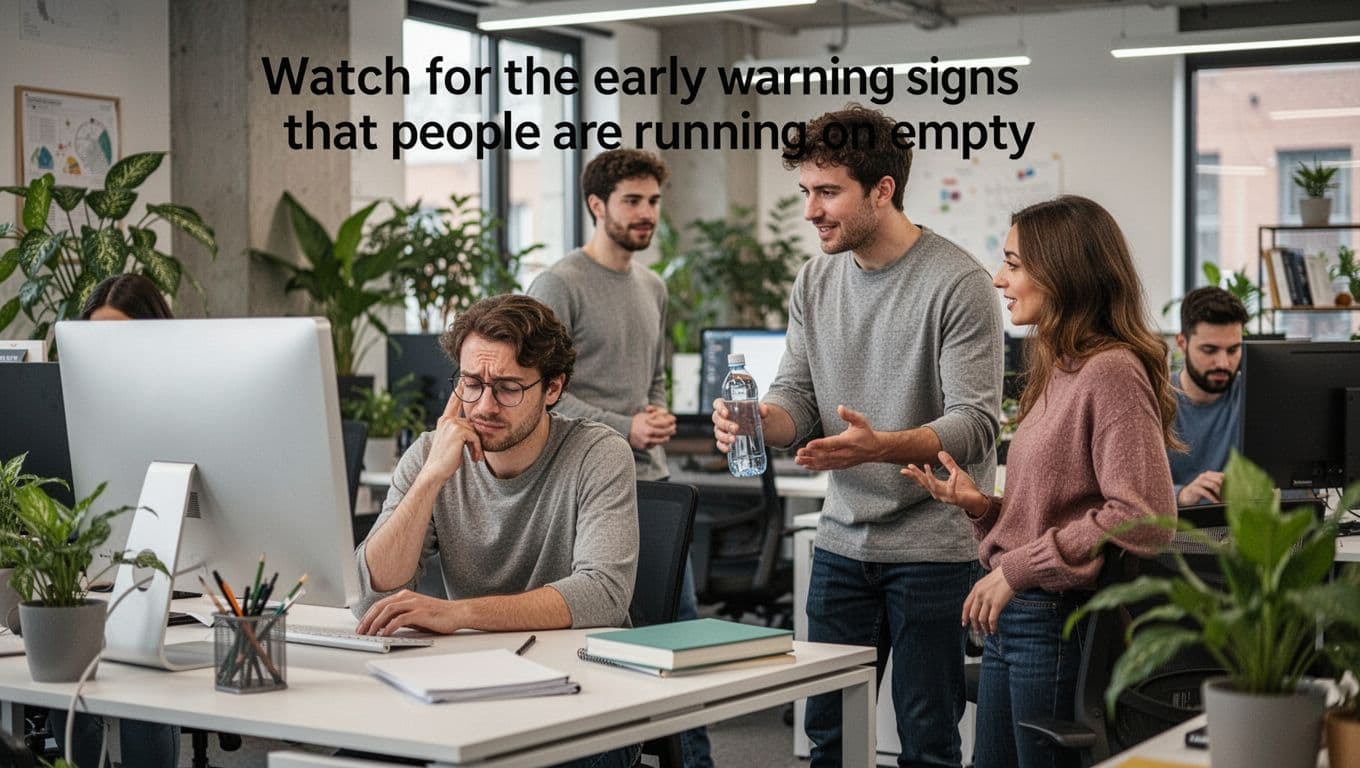
A psychologically safe team can name those signals early. Someone can say, "You seem stretched. What needs to move?" That one sentence can stop a quiet slide into full burnout. Research summarized in this overview of psychological safety in burnout prevention supports the same point: safety helps people speak before stress hardens into damage.
You do not need a perfect culture. You need a team that notices, names, and responds.
Burnout prevention is not only about reducing workload. It is also about removing fear from the work itself. Safer teams are more honest, steadier under pressure, and better at catching problems while they are still small. Start with one behavior this week: thank someone for raising a concern, ask one real question, or name your own limit out loud. That is how trust grows, and how burnout loses ground.