

Your calendar says "quick sync," but your body hears "threat." A tight chest shows up five minutes before the meeting. Your inbox piles up like wet laundry. You answer one message, and three more appear.
That's anxiety at work for a lot of people. It's not weakness. It's not a bad attitude. It's a stress response that can hijack focus, memory, and patience, even when someone cares deeply about their job.
The good news is simple: managers and teammates can support employees with anxiety without labeling anyone, forcing disclosure, or turning care into a performance. This guide sticks to practical language, small actions, and support options that protect privacy. It also acknowledges a hard truth: many wellness programs get ignored, because they ask too much. Short, guided breathing breaks can help from day one, because they fit inside real work.
Make anxiety safe to talk about, without putting anyone on the spot
"No stigma" isn't a poster. It's a thousand small moments: the tone you use in Slack, the pause before you reply, the way you talk about mistakes. People watch what gets rewarded and what gets punished. If urgency always wins, anxiety quietly spreads.
A stigma-free approach has three rules: consent, privacy, and choice. You can offer support. You can't demand a story. Employees don't owe you a diagnosis, a childhood timeline, or the details of their therapy.
If someone shares they're struggling, your job is to make it safer, not to make them explain.
Leaders set the temperature of the room, even through text. A short message like "No rush, reply by tomorrow" can relax shoulders across time zones. On the other hand, "??" at 10:47 p.m. can turn sleep into a shallow, alert nap.
Swap labels for signals you can notice
Anxiety rarely announces itself. It leaks out through behavior, because the nervous system is trying to cope. Still, those signals aren't proof of anxiety. They're cues to check in with care.
Common work signals include:
- Missed deadlines after a period of reliability
- Irritability, sharp replies, or sudden quiet
- Avoidance (camera off every time, disappearing after feedback)
- Perfection loops (can't ship, keeps re-checking, fears being wrong)
- Trouble focusing, more task switching, more doom scrolling
- More sick days, headaches, stomach issues, or "I just can't today" mornings
Use a simple notice, ask, offer approach.
Notice the change without judging it. Ask a short, respectful question. Offer two options, so they can choose without pressure.

For example: "I've noticed you've been staying late and reworking drafts. Are you feeling unclear on expectations, or is something else making this heavier?" The goal is relief and clarity, not a label.
Use simple, human phrases that reduce shame
People relax when they feel normal, not analyzed. Skip "What's wrong with you?" energy, even if you don't mean it. Use language that treats stress as a common human experience.
Here's a small script bank that works in real conversations:
- 1:1 opener: "How's your workload feeling this week, light, steady, or too much?"
- Supportive response: "Thanks for telling me. You don't need to share details to get support."
- Clarifying offer: "Want help with priorities, or do you just need fewer pings today?"
- Boundary-friendly check: "If you'd rather not talk now, that's okay. We can revisit later."
- Concrete help: "Let's pick one 'must-do' and one 'can-wait' so today feels possible."
Also, keep a short mental "avoid saying" list. "Calm down" tends to backfire. "Everyone's stressed" makes people feel alone. "Just be positive" turns pain into a personality flaw.
If you want more desk-level language and quick resets for tense moments, this piece on practical stress relief in your workday pairs well with manager support.
Build a team culture that lowers anxiety before it spikes
Anxiety loves fog. Unclear work, surprise deadlines, and shifting priorities are like walking through a dark room full of furniture. You move carefully, but you still bruise your shin.
Culture isn't pep talks. It's systems. When work feels steadier, people make fewer mistakes, recover faster after tough days, and stay longer. Stress and anxiety don't just feel bad, they also show up as churn, rework, and fragile teamwork.
This matters even more for young professionals. Many already feel pressure from rising costs, constant notifications, and the fear of falling behind. Work shouldn't add extra chaos for sport.
Make work feel predictable with clearer expectations
Clarity lowers anxiety because it reduces guessing. Most people don't fear hard work. They fear hidden rules.
Start with small, repeatable moves:
Write down the "definition of done" for recurring tasks. Share priorities in plain language, not hints. Assign a clear decision owner, so feedback doesn't arrive as surprise vetoes. Post a weekly "what matters this week" note, even if it's only five lines.
Response-time norms also matter. If everything is urgent, nothing is safe. Agree on basics like "Messages after 6 p.m. can wait unless it's tagged urgent," and then model it. A manager who sends late-night pings trains the team to stay on alert.
When you must move fast, name the tradeoff. "We're choosing speed over polish this week" gives people permission to stop perfection spirals.
Design meetings that don't drain the nervous system
Meetings can feel like small stages. If someone already runs anxious, a meeting-heavy day can become a marathon of masked breathing.
Make meetings lighter by default. Share an agenda first. Make attendance optional when possible. Normalize camera-optional, especially for internal calls. Add two quiet minutes to read, so fast talkers don't dominate.
Shorter defaults help too. Try 25 minutes instead of 30, or 50 instead of 60. End with a recap that answers: "What did we decide, who owns what, and when is it due?"

After a tense meeting, suggest a tiny reset. "Take three breaths before jumping to the next call" sounds almost too small, yet it works because it interrupts the stress loop. Those micro-pauses stop the day from turning into one long clench.
Offer support options that respect privacy and choice
The best support looks like a menu, not a mandate. People differ in what helps, and they differ in what they're ready to share.
A strong menu usually includes three layers:
Self-serve tools for private moments. Peer support for connection. Professional care for deeper help. In addition, company programs work best when reporting stays anonymized, so employees can use support without worrying about career impact.
If you're building a company approach, a wellness platform to manage work anxiety can help teams offer guided breathing with real adoption and minimal setup. That matters because many "wellness" tools fail for a simple reason: they demand too much time, too much belief, or too much public participation.
Give people quick tools for anxious moments, not another big task
When anxiety hits at work, nobody wants homework. They want a reset button that fits between calls.
A 3 to 5-minute guided breathing session can work at a desk because it's discreet. It's also practical because breathing is biology. Slow, steady patterns shift the body out of threat mode.
Two common options are easy to explain:
Box breathing uses equal counts (inhale, hold, exhale, hold). It's steadying, like tapping a metronome for your nervous system. Resonant breathing slows the breath to a comfortable rhythm, which many people find calming without effort.
That's why Pausa exists. It's a guided breathwork app made for real life, especially for people who don't meditate. It was created after the founders went through panic attacks and searched for simple tools that helped in the moment, not someday. Pausa is available on iOS and Android, and it also nudges healthier screen habits by encouraging intentional pauses instead of endless scrolling. You can try it here: https://pausaapp.com/en.
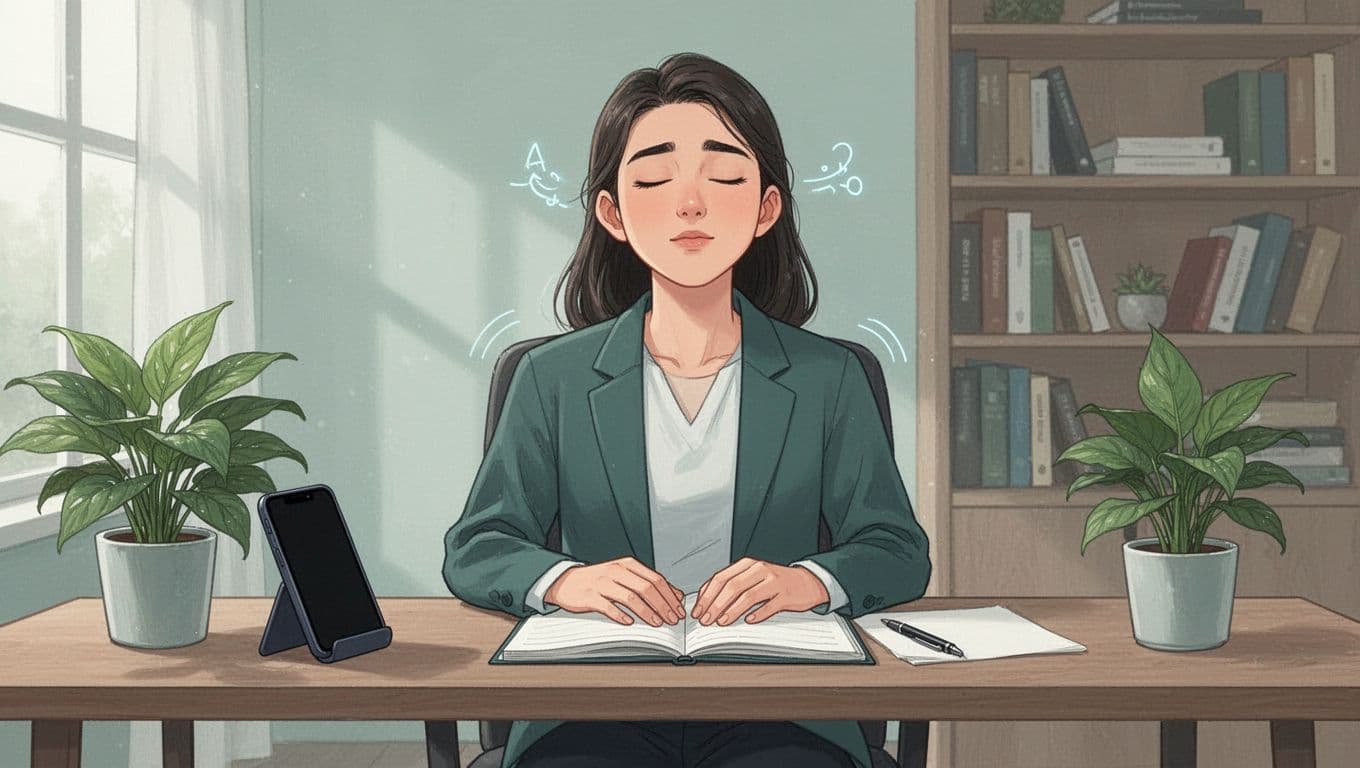
The hidden benefit is emotional. Guided sessions can feel like quiet companionship. When someone is anxious, being alone in your head is often the worst part.
Know when to point to professional help, and how to do it well
Managers can support, but they can't diagnose. That line protects everyone.
Offer care, offer resources, and offer adjustments. Don't try to name someone's condition.
If someone's anxiety is intense, persistent, or affecting daily life, encourage professional support in a matter-of-fact way. You can say, "I'm not a clinician, but you don't have to carry this alone. If you're open to it, an EAP or therapist could help."
For urgent situations (talk of self-harm, panic that feels out of control, inability to function), treat it as urgent and follow your company's safety process. If you're unsure, escalate to HR or your people ops lead immediately.
Self-check tools can also build awareness, but they aren't diagnoses. They can help someone name what they feel, then choose the next step with more clarity.
Turn good intentions into habits your team can keep
A supportive culture doesn't require perfection. It needs repeatable habits that survive busy weeks.
Think in timeframes. This week, pick one change that reduces friction. This month, adjust one system that causes avoidable stress. Over time, watch signals that hint at strain: rising meeting load, slower cycle times, lower engagement, more last-minute work, and quiet turnover intent.
Small pauses add up, but only if people actually use them. Adoption matters more than a beautiful plan.
A simple weekly routine for managers and teams
Keep it light, so it doesn't become another burden.
Start with a 10-minute priorities sync each Monday. Name the top three outcomes, then name what's not happening. Hold one private check-in slot each week where employees can talk, or simply request clarity. Add a "no meeting" block for deep work, even if it's only 90 minutes.
Finally, set a shared norm for breaks. Make it explicit and opt-in: "If you need a five-minute reset after a tough call, take it." Some teams also like an optional two-minute breathing break at the start of a weekly meeting, with cameras optional and zero pressure.
If movement helps your group, you can also share a resource like these simple workouts to calm your body fast and let people choose what fits.
Conclusion
Supporting employees with anxiety without stigma comes down to three moves: use shame-free language, design work that feels clearer and more predictable, and offer private tools people will actually use. You don't need to fix anyone. You need to lower the pressure points that make anxiety flare.
Pick one change today, a better script, a meeting norm, or a five-minute breathing pause, and repeat it until it becomes normal. Consistency is how safety starts to feel real at work.