

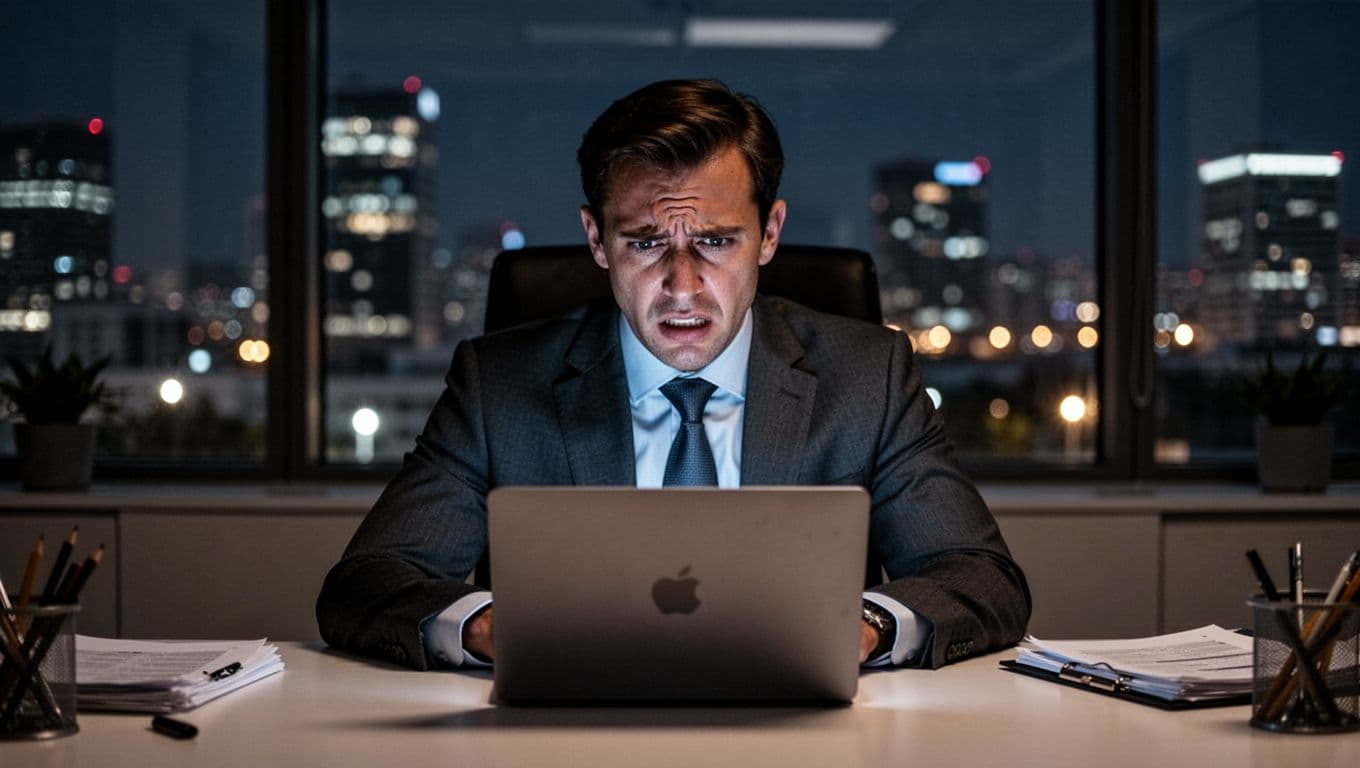
 Late-night work often looks productive, until it starts taking your sleep. Created with AI.
You can run a company on pressure for a while. The late-night email streak. The airport days. The "just one more thing" mindset. It works, until it doesn't.
Here's the loop most high performers get trapped in: stress keeps your nervous system switched on, so sleep gets lighter. Then the next day feels harder, so you push more. As a result, stress climbs again. Same loop, tighter spiral.
This isn't about willpower. It's about physiology meeting modern work.
This post is a practical map. You'll learn how to spot the sleep and stress cycle early, what's happening in your body, and how to break it with steps that fit real schedules.
And yes, breathing is part of the fix. Not the performative kind. Pausa was created after real panic attacks, built for short, guided breathing pauses, not long meditation sessions. Open it, breathe for a few minutes, get back to your day.
The sleep and stress cycle, what is happening in your brain and body
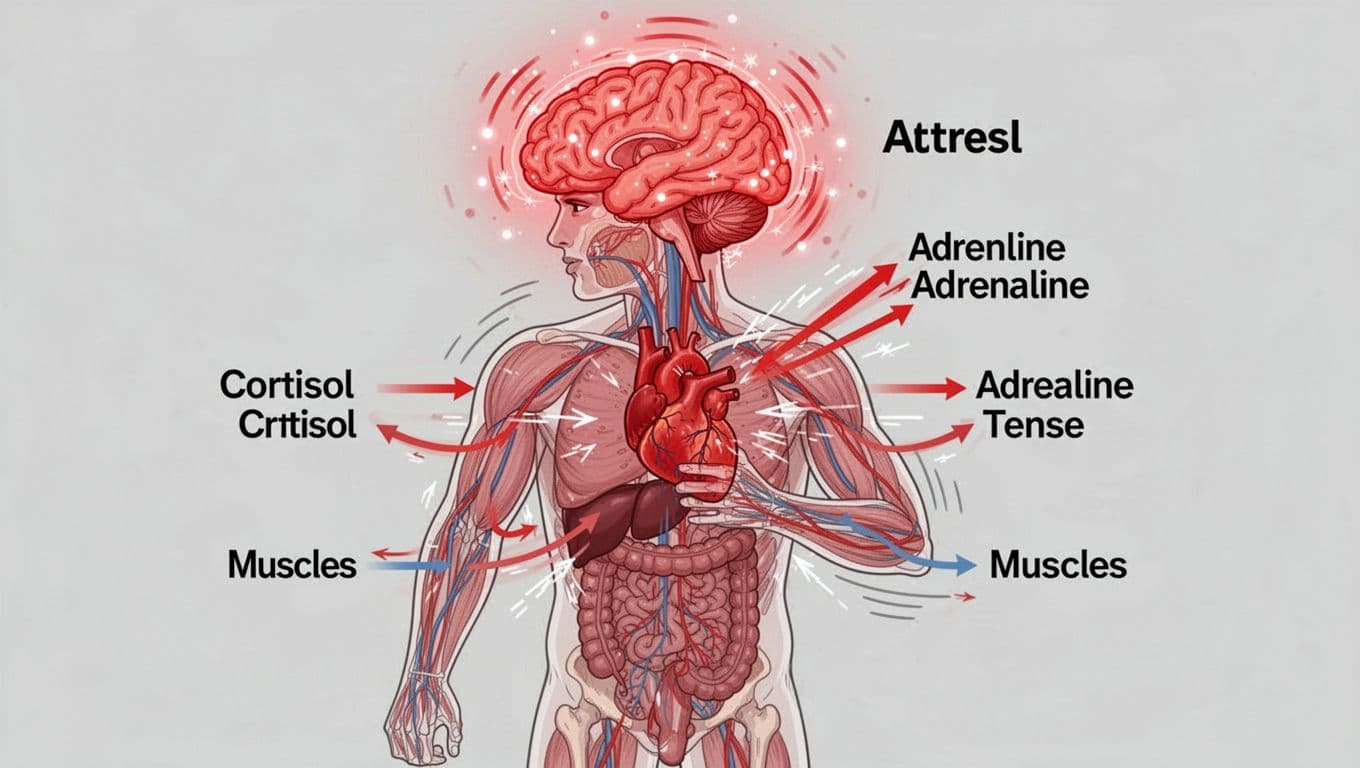 Stress is a full-body event, not a mindset problem. Created with AI.
Your brain has two modes that matter here: safe and unsafe. When it senses threat, it pushes your body into fight-or-flight. That mode is powered by stress chemistry, mainly cortisol and adrenaline.
Those chemicals are useful at 2 p.m. They help you focus, move fast, and power through a deadline. They're also terrible at 2 a.m.
At night, sleep needs a downshift. A slower heart rate. A calmer breath. Lower alert signals. When stress stays high, your body doesn't "forget" bedtime. It refuses it.
This cycle hits high performers hard because many are more sleep reactive. Stress doesn't just annoy them, it alters sleep quality fast. Then the bad sleep makes stress easier to trigger the next day. A feedback loop.
Common signs leaders recognize:
- Racing thoughts the moment the lights go off
- Waking at 3 a.m. with a problem already loaded
- Light sleep that breaks with every sound
- Tight jaw, clenched shoulders, shallow breaths
- Doom scrolling because it feels like rest (it isn't)
- Feeling tired but wired, even after a long day
Recent data lines up with what leaders feel in their bodies. Executive stress is rising, and many report feeling more stressed than the year before, as captured in the 2026 C-Suite Stress Index. That matters because stress doesn't stay in a slide deck. It shows up in sleep.
Sleep isn't the reward for finishing the day. It's the system that makes tomorrow workable.
Why stressed leaders cannot shut off at night (and why it feels personal)
When work gets loud, your brain keeps running simulations. You replay the meeting. You draft the response. You plan the apology. You run the numbers again.
That's rumination. It's not character. It's pattern-matching under threat.
Meanwhile, stress can keep nighttime cortisol elevated. Your body stays ready for action. So you get that cruel experience: your eyes feel heavy, but your mind won't dim.
Then a second layer shows up: sleep anxiety. You start worrying about not sleeping. You check the clock. You calculate the damage. You try harder.
Trying harder backfires because sleep is a release, not a grip. The more you chase it, the more alert you become.
If this is you, don't make it moral. Your biology is doing what it was designed to do. It just wasn't designed for inboxes at midnight.
What poor sleep does to performance the next day
Bad sleep doesn't just make you tired. It makes you sharp in the wrong way.
The next day, your brain gets more reactive. Judgment gets noisier. Small problems feel bigger. You interrupt more. You recover slower after conflict. Focus fractures, and mistakes creep in.
That's not "soft stuff." That's operational risk.
Surveys over 2025 and 2026 keep pointing to the same blockers. In recent global sleep polling, stress and anxiety show up as a top barrier to sleep at about 39%, work is another common barrier at about 22%, and screens are close behind at about 21%. One example is Resmed's Global Sleep Survey release (March 2026).
Put those together and you get the modern executive trap: the same inputs that "help" you perform also steal recovery.
So performance suffers twice. First from the stress itself. Then from the sleep loss that follows.
The high performer traps that quietly keep the cycle going
High performers don't usually fail because they don't know what sleep hygiene is. They fail because the workday has teeth, and their coping tools are built for output.
These traps look responsible on paper. They're also sleep killers.
Late caffeine is the classic one. You don't feel it, until you do. Then it's 1 a.m. and your heart is still negotiating.
Late workouts can help some people, but intense training too close to bed can keep adrenaline high. Your body reads it as "stay alert."
Alcohol is another common trick. It can knock you down fast. It often fragments sleep later. You wake up, and your brain starts its 3 a.m. shift.
Checking email in bed is worse than most leaders admit. You turn the bedroom into a command center. Your brain learns: pillow equals problems.
Perfectionism adds fuel. Not the healthy "care about the work" kind. The kind where the day never ends because nothing is finished enough.
Travel makes everything harder. New beds, time zones, early calls, late dinners, and no routine. Then you blame yourself for not sleeping. The loop tightens.
If you want a simple, desk-level way to interrupt stress before it becomes nighttime rumination, this guide on quick office stress relief techniques maps well to executive schedules.
One more issue sits above personal habits: company norms.
After-hours messaging. Meeting overload. "Always available" as a quiet promotion requirement. These norms keep everyone's nervous system on alert. Even the people who look fine.
Always on culture, screens, and the bedtime negotiation you lose
Screens don't just shine light. They carry unfinished business.
Notifications pull you back into social threat and work threat. Blue light can delay wind-down for some people, but mental stimulation is the bigger problem for leaders. You read one tense thread, and your brain starts preparing for impact.
Many people normalize this. They joke about four hours of sleep. They call it hustle. Meanwhile, the cost shows up as irritability, memory lapses, and a shorter fuse.
The problem often stays hidden until it becomes burnout.
Burnout is often a sleep problem first, then it becomes a work problem
Burnout isn't mystical. It's a pattern: exhaustion, cynicism, reduced effectiveness.
Sleep loss makes that pattern easier to enter. Stress keeps the body revved. The workday drains you. Then sleep fails to refill the tank. Repeat.
At the top, the damage can be quiet but real: less creativity, worse decisions, more conflict, and slower recovery after setbacks.
Plenty of leaders are feeling it. Reports about CEO strain and burnout keep surfacing, including the stat-heavy framing in why 71% of CEOs report burnout. The exact number matters less than the direction. Leaders are running hot, and sleep is part of the bill.
How to break the loop without adding another big habit to your schedule
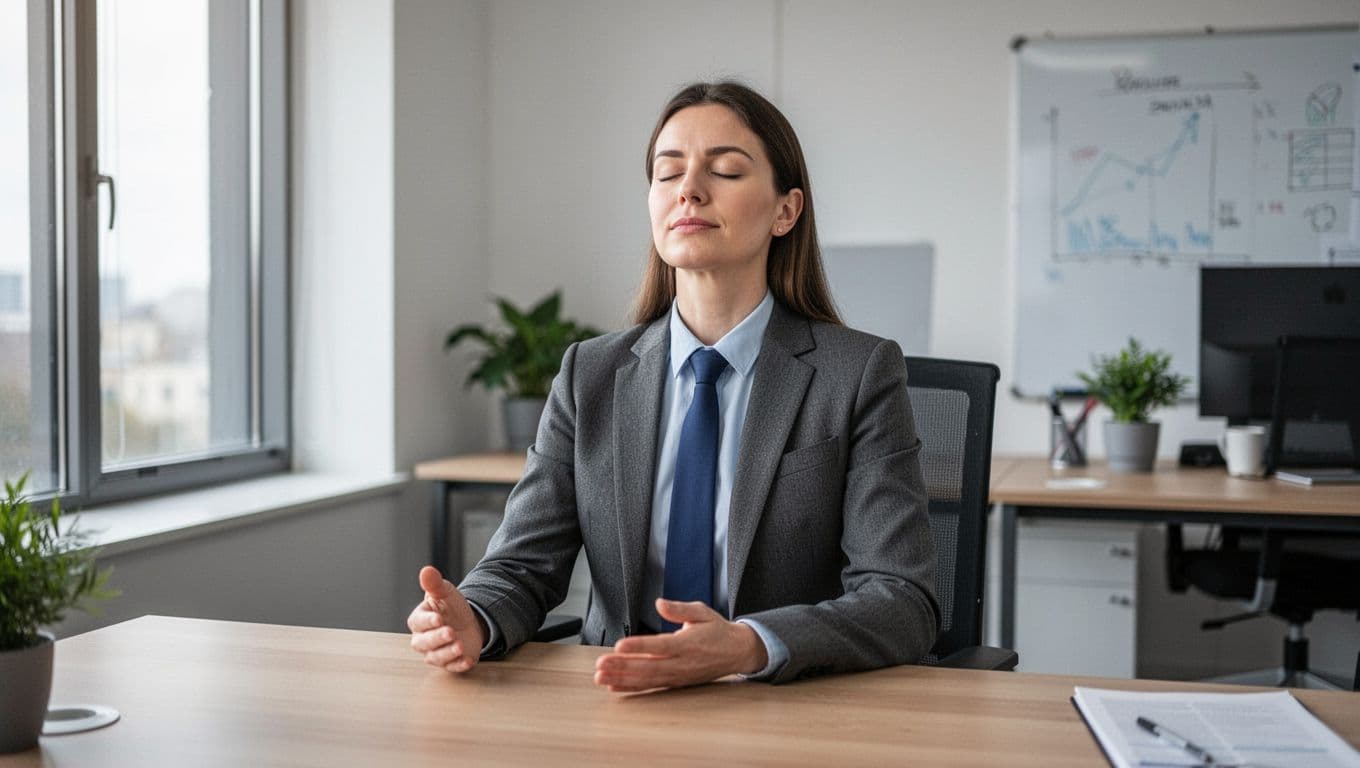 Short pauses can change how the day feels, and how the night goes. Created with AI.
Breaking the cycle means attacking both sides.
Lower stress during the day, so your system can downshift at night. Protect sleep, so stress doesn't spike the next day.
Here's a leader-proof playbook. Simple by design.
First, set a consistent wake time. Not a perfect one, a consistent one. Sleep pressure builds from wake time forward. When wake time swings, sleep becomes harder to predict.
Next, create a 30 to 60-minute wind-down buffer. Treat it like a runway. Dim lights. Lower stimulation. Stop new inputs.
Then add one screen boundary you can actually keep. For example, phones out of bed. Or no email after the wind-down starts. Pick one rule that survives travel and bad days.
After that, fix the room. Cool, dark, quiet. If you can't control noise, use a fan or white noise. If light leaks in, use a simple mask. Don't romanticize it. Make it functional.
During the day, write the worry list earlier. Not at night. A 5-minute "open loops" note at 4 p.m. works well. You park the problems before they move into bed with you.
Finally, use naps like a tool, not a lifestyle. A 20-minute nap in the early afternoon can help when sleep debt is real. Keep it short. Keep it early. Otherwise it steals from the night.
In the middle of all this, you still need a fast downshift. That's where breathing earns its keep.
Pausa is built for people who don't want a new identity called "meditator." Sessions are short. Guidance is audio. The goal is fewer doom-scroll minutes, more intentional pauses. It's also available on iOS and Android, which matters because stress doesn't wait for your calendar.
If a habit needs a perfect day, it's not a habit. It's a fantasy.
A 5 minute nervous system reset you can do before bed or after a hard meeting
Use breathing like a circuit breaker. You don't need candles. You need a pattern.
Box breathing (equal inhale, hold, exhale, hold) works well before a presentation or right after a tense email. It's structured. It gives your mind a track to run on, instead of spiraling.
Resonant-style slow breathing (steady, comfortable, slower breaths) fits best before bed. Keep it gentle. Think "lower the volume," not "push harder." Many people find this is the fastest path into a calmer body.
The physiological sigh (a double inhale, then a long exhale) is a spike tool. Use it after conflict, after bad news, or when you feel that sudden chest tightness. It's quick. It interrupts the stress surge.
Pausa guides these kinds of short sessions, using science-backed techniques, without turning it into a 30-minute ceremony. That matters for high performers because time is scarce, and compliance is fragile.
If your team experiments with more intense breathwork, treat it with respect. Some methods can feel energizing, even edgy, and they're not always a fit before sleep. This breakdown of the Wim Hof breathing technique for teams explains where it fits, and where calmer options win.
What leaders can change at the company level so sleep is not a private struggle
Personal habits matter. Culture matters more.
If your org rewards instant replies, people will carry work to bed. If meetings fill every gap, recovery disappears. If "always on" is the unspoken standard, sleep becomes a private failure.
Leaders can change this without speeches.
Model a real boundary. Put a "send later" habit on after-hours messages. Protect focus blocks by removing status meetings that exist out of fear. Build micro-breaks into long sessions. Normalize a two-minute reset before hard conversations.
Also, make support easy to use. Most employees won't book therapy because it feels like exposure. Many won't attend a wellness workshop because it feels performative. They will use a tool that works in silence.
Pausa Business is built for that. It gives every employee access to guided breathing that works from day one. No training. No group confession. Adoption comes from low friction. Leaders also get anonymized engagement insights, so you can see if the program is used without making mental health a surveillance project.
Calmer teams aren't just nicer. They make fewer mistakes. They handle conflict faster. They sleep better, and they show up less reactive.
Conclusion
The sleep and stress cycle in high performers is simple: stress keeps your system on, sleep gets lighter, and the next day pushes stress even higher.
The way out is also simple, but not easy: protect sleep, downshift stress daily, and change the norms that keep people braced.
Start today with two moves. Pick one sleep boundary you'll keep this week. Then add one five-minute breathing pause after a hard meeting or before bed. Make it small, then make it repeatable.
Once it works for you, scale it. Give your team the same low-friction support with Pausa Business, so sleep isn't a private struggle hidden behind good performance.